Chilime
- Page status
- Working page
- Updated
- 2026-08-30
Summary
22 MW · operating · on the Chilime · in Rasuwa district.
Specifications
| Parameter | Value |
|---|---|
| Capacity | 22 MW |
| Status | Operating |
| Registry licence | Operation |
| River | Chilime |
| District | Rasuwa |
| Province | Bagmati Pradesh |
Output
| Parameter | Value |
|---|---|
| Annual design energy | 132.9 GWh |
| Q-design | Q65+ |
| Type | RoR |
Governance
| Parameter | Value |
|---|---|
| Developer | Chilime Hydropower Company Limited |
Schedule
| Parameter | Value |
|---|---|
| Commercial operation | 2003 |
| Completion | 100 % |
August 2026 Flood Damage
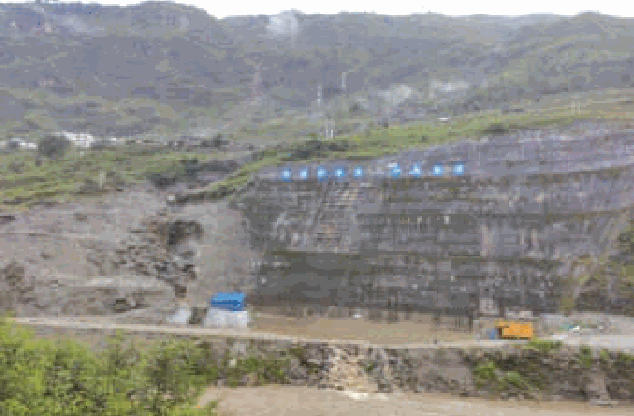
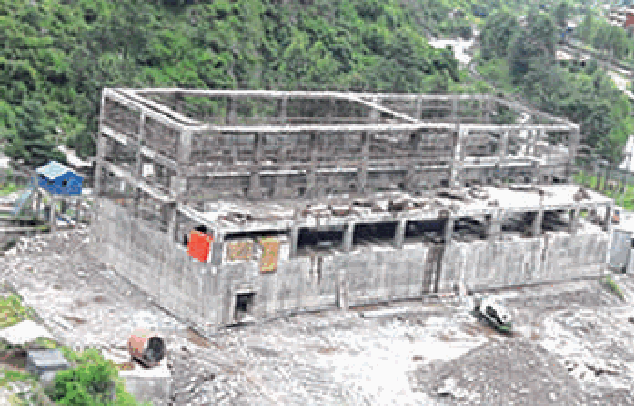
On 26 August 2026, the Bhote Koshi avalanche flood on the adjacent Trishuli corridor buried the plant. NEA's spokesperson reported the project "buried"; the company's executive director described a tunnel filled with mud — impossible to enter — and damage to the tunnel and powerhouse, with eight people including employees out of contact (six believed inside the tunnel) and a rock-climbing rescue team being mobilised. Chilime shares fell 10.12 percent on NEPSE on 26 August. See Kathmandu Post — Flood damage to Nepal's hydropower sector could run into billions (2026), Kathmandu Post — Hundreds feared trapped in hydropower tunnels after Bhotekoshi flood (2026) and Bhotekoshi–Trishuli Flood 2026.
The Chilime group's subsidiary structure concentrates this exposure: Rasuwagadhi (33 percent CHCL-held, destroyed in the same flood), Sanjen and Madhya Bhotekoshi sit in the same Rasuwa corridor system.
Significance / Why It Matters
Chilime is the sector's most cited success case — and its performance metrics justify the reputation. However, the conditions that produced those metrics are not replicable for modern projects. See Limitations & Controversies below.
Generation overperformance
Chilime consistently generates above its contracted energy, a rarity in Nepal's hydro sector:
| Fiscal Year | Contracted (GWh/yr) | Actual (GWh/yr) | % of Contracted |
|---|---|---|---|
| FY 2075/76 (~2018/19) | 132.9 | 153.7 | 115.6% |
| FY 2076/77 (~2019/20) | 132.9 | 146.3 | 110.1% |
Source: Chilime Hydropower Company Limited annual reports.
This overperformance places Chilime in stark contrast to modern IPPs, where zero of 100+ projects evaluated in a recent Urja Khabar audit exceeded 80% of contracted energy. See Q-Design Discharge for the full generation performance comparison.
Limitations & Controversies
Chilime's success is not a replicable baseline for modern hydropower projects. The conditions that produced its performance are a product of a different regulatory, financial, and climatic era:
Conservative Q-design: Chilime was commissioned in 2003 and likely designed on Q65 or higher — a more cautious flow percentile than the Q40–Q45 now permitted under current DoED guidelines. This means its contracted energy was set conservatively low relative to actual hydrology.
Reliable snow-fed basin: The Chilime River is a snow-fed system with less seasonal volatility than the monsoon-dominated, rain-fed tributaries where most modern IPPs are located.
Pre-climate-shift commissioning: Chilime entered operation before the acceleration of cryospheric melt and shifting monsoon patterns that now undermine the stationarity assumption in hydrological models.
Lower financial leverage: Built in an era of lower construction costs and lower debt leverage, Chilime never faced the Debt Service Coverage Ratio pressures that now push post-2015 projects into technical default. See Q-Design Discharge for DSCR break-point analysis.
NEA subsidiary status and PPA rate advantage (VERIFIED): Chilime is an NEA subsidiary (NEA retains 51% controlling stake). Its PPA, signed June 25, 1997, uses a dual-tier billing architecture categorically different from modern IPPs:
Category Tariff (NPR/kWh) FY2078/79 Volume (GWh) FY2078/79 Revenue (NPR) Regular Energy 8.17 133.24 1,088,000,000 Excess Energy 4.08 22.82 93,110,000 Total 7.57 (blended) 156.06 1,181,740,179 Source: Chilime Hydropower Company Limited Annual Report FY2078/79. VERIFIED.
This billing architecture — not the per-unit rate alone — is the mechanism of the subsidy. Unlike modern IPPs, which must classify generation by season (wet/dry), Chilime categorizes output as "Regular" vs "Excess." In FY2078/79, 85.4% of total generation (133.24 of 156.06 GWh) was classified as Regular Energy and billed at the premium NPR 8.17 rate year-round — regardless of season. A comparable private IPP must sell the majority of its monsoon-heavy generation at the depressed NPR 4.80 wet-season rate.
Quantified rate differential:
- Chilime blended rate: NPR 7.57/kWh
- Private IPP baseline (optimized 20% dry energy mix): (0.20 × 8.40) + (0.80 × 4.80) = NPR 5.52/kWh
- Differential: NPR 2.05/kWh = 37.1% revenue advantage per unit
- For a 50 MW comparable private IPP generating 200 GWh/year, this represents approximately NPR 410 million in foregone annual revenue
External academic verification: The Fenner School of Environment and Society (Australian National University), Nepal State of Knowledge Report — Renewables and PSH, independently documents this dynamic:
"The major complaint of the rising IPPs is that the playing field is not level, that NEA as generator, transmitter and distributor gives preferential terms to its own projects compared to IPPs; and indeed, this is seen in the case of the Chilime hydropower company that is owned by the NEA and its staff."
Citation: Fenner School of Environment and Society, ANU, Nepal State of Knowledge Report — Renewables & PSH, p. 20. URL: https://fennerschool.anu.edu.au/files/Nepal%20State%20of%20Knowledge%20Report%20-%20Renewables%20%26%20PSH.pdf.
See PPA Pricing for the full rate comparison table and NEA Triple-Authority Conflict for the institutional framework.
IPO after profitability, not before: Chilime's 2010 IPO occurred after seven years of profitable operations, enabling the company to distribute a 35% cash dividend within a year of listing. Modern hydro IPOs are routinely floated pre-commissioning or immediately post-COD, when the project is hemorrhaging cash from capitalized interest. See IPO Hydropower Bailout.
Chilime's subsequent role as a holding company — spinning off subsidiaries (Rasuwagadhi, Sanjen, Madhya Bhotekoshi) to bypass the terminal BOOT-model asset handover — further reflects a business environment that no longer exists for new entrants.
Notes
Related
- Run-of-River Hydropower
- Q-Design Discharge
- NEA Triple-Authority Conflict
- PPA Pricing
- IPO Hydropower Bailout
- Bhotekoshi–Trishuli Flood 2026