NEA Triple-Authority Conflict
A governance concept describing the conflict risk created when dispatch, purchasing and penalty administration are concentrated around one utility; public evidence does not establish discriminatory dispatch or a proven Barahi outcome.
- Page status
- Working page
- Updated
- 2026-11-04
- Last reviewed
- 2026-11-04
- Review due
- 2027-02-04
Summary
The NEA Triple-Authority Conflict is an analytical description of the governance risk created when the Nepal Electricity Authority is involved in dispatch, electricity purchasing and administration of contractual deductions. Concentrating these functions can create conflicts of interest and weak appeal pathways. It does not, by itself, prove discriminatory dispatch, unlawful deductions or a particular project's loss.
Simple Explanation
The concern is procedural: a generator may depend on the same utility for dispatch instructions, payment and application of contractual penalties. A credible system therefore needs transparent rules, auditable records and a review mechanism that affected parties can use.
One Utility, Several Roles
NEA's own FY 2025/26 annual report documents how many roles meet in one institution (NEA Annual Report FY 2025/26):
| Role | Evidence (FY 2025/26) |
|---|---|
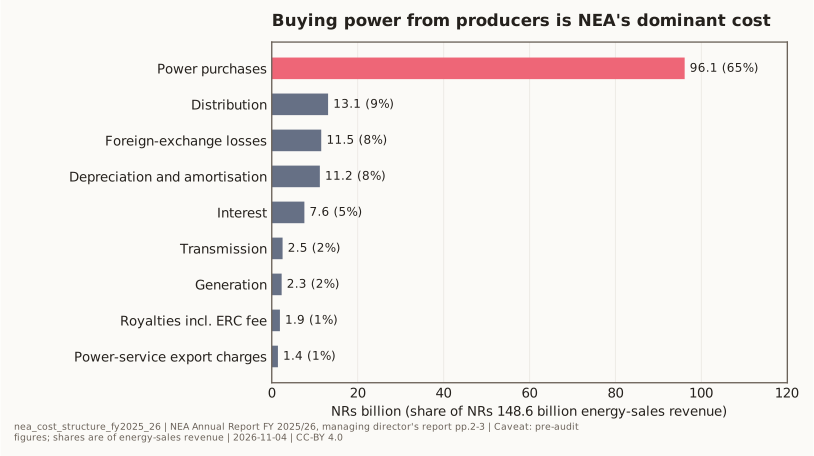
| Main buyer | 545 power purchase agreements with independent producers, totalling 12,135 MW (PDF p.14); power purchases of NPR 96.1 billion (PDF p.13) |
| Generator | NEA and its subsidiaries supplied 36% of energy available; independent producers 58% (PDF p.13) |
| System operator | NEA's System Operation Department, "commonly known as the Load Dispatch Centre", is "the apex control center for Nepal's power system" (PDF p.53) |
| Transmission owner and developer | 7,110 circuit-km of high-voltage lines and 15,541 MVA of substations (PDF p.14) |
| Distributor and retailer | 5.927 million consumers (PDF p.12) |
| Cross-border trader | Bids into Indian day-ahead and real-time markets and runs bilateral export agreements (PDF pp.14, 53) |
| Contract administrator | Applies availability-declaration and related provisions under its PPAs (Availability-Declaration Penalties) |
Each role is ordinary for a vertically integrated utility. The governance question is what happens when the same institution that dispatches the grid and judges contract compliance also carries the purchase obligations and owns competing generation.
Why the Roles Matter for the Seasonal Problem
The seasonal swing turns these roles into money. In the monsoon the system is long: NEA must take contracted energy, export what it can and decide which plants to curtail when lines are full. NEA names minimising generation curtailment as a challenge but does not publish curtailment by plant (PDF p.12). In the dry season the system is short: NEA dispatches what is available and imports the rest, paying about NPR 9.0 per kWh for imports on its summary totals (PDF p.14).
Every one of those decisions affects NEA's own balance sheet. Purchases are its largest cost, and foreign-exchange losses on its loans reached NPR 11.5 billion in FY 2025/26 (PDF pp.12–13). An institution under that pressure has an incentive to minimise payments, and it controls the dispatch instructions and penalty calculations that determine them. That is the structural conflict. Whether it changes outcomes cannot be tested without dispatch, availability and penalty records, which are not public.
The exposure will grow. NEA's 545 signed agreements with independent producers total 12,135 MW (PDF p.14), roughly three times the 4,120 MW installed across all owners in FY 2025/26. As those projects commission, more of the monsoon surplus will be contracted energy that NEA must buy, export or curtail, and more of its dispatch decisions will carry a direct financial consequence for its own accounts.
The Contract Mechanism in Brief
The conflict is sharpest in the availability-declaration (AD) provisions of the standard power purchase agreement. As reported in secondary analysis of the standard wording, a producer declares in advance how much energy it will make available. If delivered energy falls below 80% of the lower of its monthly contract energy and its declaration, after allowing for scheduled outages, forced outages and force majeure, the producer compensates the buyer for the shortfall at the purchase rate (Availability-Declaration Penalties, NEA Standard Hydropower PPA Clauses — AD Penalty, Reserve Margin, and Curtailment).
Two features matter for the conflict. First, the same reported wording contains no explicit relief when the buyer's own dispatch instruction reduces delivery, such as curtailment in a congested monsoon week. Second, the declaration, the dispatch instruction and the shortfall calculation all sit with the buyer. A producer who believes it was curtailed rather than unavailable has to contest the calculation with the institution that made it.
These points come from analysis of standard wording, not a census of signed contracts, and no public ledger shows how often deductions are applied, waived or disputed. They explain why the arrangement is a conflict risk. They do not show how often it causes harm.
Questions an Audit Would Answer
The structural concern can be tested. The data exist inside NEA; they are not published:
- For each plant and month, the declared availability, the dispatch instruction and the energy accepted.
- Curtailment events, with the network or system reason recorded.
- Deductions assessed, waived, disputed and recovered, by plant and by owner type.
- Dispute outcomes at NEA, the Electricity Regulatory Commission or in arbitration, with the contract version applied.
Publishing these, even in anonymised form, would let anyone check whether the conflict changes outcomes (Decision Dossier — Hydropower Securities Disclosure, Decision Dossier — Power-System Role Separation and Open Access).
What the Current Evidence Establishes
- NEA Annual Report FY 2024/25 records electricity supplied by NEA and its subsidiaries, independent producers and imports, while NEA operates central parts of the transmission and distribution system.
- NEA Standard Hydropower PPA Clauses — AD Penalty, Reserve Margin, and Curtailment and AD Penalty Clause in Nepal's PPA — Research Compilation report availability-declaration, reserve-margin and curtailment provisions through secondary legal analysis. They are not a corpus of signed project PPAs and are not a formal legal opinion.
- The Electricity Regulatory Commission issued the Directive on Open Access in Transmission and Distribution System on 9 January 2026 (ERC Open Access Directive 2082; Pioneer Law brief) and set the first national transmission charges for FY 2026/27: NPR 412,755 per MW per month for long- and medium-term use and 57 paisa per kWh short-term (The Rising Nepal, 2 Oct 2026). Metering, deviation-settlement, grievance and balancing directives were still in draft in September 2026 (Spotlight Nepal, 15 Sep 2026). Issuance does not yet demonstrate operational third-party trading.
- The available evidence is sufficient to identify a structural conflict risk. It is not sufficient to measure how dispatch or deductions are applied across projects.
What Is Not Established
- A project-level pattern of dispatch discrimination after controlling for plant availability, location, network constraints and contract terms.
- A public merit-order, dispatch-instruction or accepted-energy dataset that permits ownership comparisons.
- A representative set of signed PPAs showing whether curtailment relief and dispute clauses vary by project.
- A project-by-project ledger of penalties assessed, waived, disputed, adjudicated or recovered.
- A primary audited filing, ERC decision or court record establishing the reported Barahi Hydropower outcome.
The Barahi Research Lead
Legacy pages treated Barahi Hydropower as an audited demonstration of the conflict. The audited statement, fiscal year, applicable PPA and regulatory or adjudication record are not present in the current corpus. Barahi must therefore remain a research lead, not proof of the mechanism in operation.
No sector-wide penalty share should be inferred from the reported case or from the standard-contract formula. The public evidence needed for such a measure is not available here.
Governance Options
Open access is the first structural change under way: it lets eligible generators and large consumers use NEA's network for a regulated fee instead of selling only to NEA. It does not, by itself, separate dispatch from purchasing or give producers an independent forum for penalty disputes.
Possible responses include publishing dispatch and penalty records, operationalising open access under current institutions, ring-fencing dispatch functions, creating an independent operator, or establishing a neutral penalty-review pathway. Their legal requirements, cost and effectiveness have not been compared in the current source set.
See Decision Dossier — Power-System Role Separation and Open Access for the evidence-led Decision Dossier, including response options, trade-offs and the visibly labelled TransparentGov assessment.
Common Misunderstandings
- A structural conflict is not proof of misconduct. The institutional arrangement creates a risk that needs controls and evidence.
- A complaint recorded in an academic or industry report is not a dispatch audit. It can identify an issue for investigation without establishing its frequency or cause.
- Secondary standard-PPA analysis is not a signed-contract census. Clause wording and enforcement may vary.
- Barahi is not currently an audited case in this wiki. The primary filing and adjudication trail are missing.
What Would Change Our Mind
- Published plant-level dispatch, curtailment and availability records showing that curtailment and penalties fall evenly across NEA-owned, subsidiary and private plants after controlling for location, network constraints and contract terms.
- An operating independent system operator, or a ring-fenced dispatch function with its own published rules and audit, which would remove the structural basis of the conflict.
- Open access working at scale, with third-party sales large enough that NEA is no longer the only practical buyer.
Related
- Decision Dossier — Power-System Role Separation and Open Access
- Availability-Declaration Penalties
- Stranded Generation
- Governance Weakness Wastes Hydro Opportunity Through Delays and Misaligned Incentives
- Institutions, Finance and Project Delivery
Update History
| Date | Change |
|---|---|
| 2026-11-04 | Added NEA's roles from the FY 2025/26 annual report, the cost-structure exhibit, the seasonal mechanism, 2026 open-access status and conditions for revision |
| 2026-07-19 | Barahi reclassified as a research lead; evidence limits made explicit |
| 2026-05-02 | Created |