IPSDP Milestone Ladder 2022-2040
- Page status
- Working page
- Updated
- 2026-04-22
Summary
Dated milestones and named project buckets from the JICA/MoEWRI IPSDP executive summary figure (Figure 3.1-1), covering 2022–2040. Captures the official state-planning timeline: exports surpass imports (2025), self-sufficiency (2033), 28,000 MW target (2035), regional clean export (2040).
Coverage / Method
- Data source: MoEWRI IPSDP Executive Summary 2025, Figure 3.1-1 ("Development Milestones and Pathways in IPSDP").
- Method: Milestones and era buckets extracted from the executive-summary figure via visual inspection. Year-by-year capacity/demand/export traces are too compressed in the figure to transcribe with confidence; this page captures milestones and named projects only.
- Known gaps: No machine-readable year-by-year table of installed capacity, demand, and export values from the IPSDP study has been extracted. Higher-resolution source or manual chart digitization needed for numeric time series.
Caveats
- Graphic extraction: Milestones are read from a compressed executive-summary figure, not from a data table.
- Milestones are planning targets, not forecasts: The 2025 export-crossover, 2033 self-sufficiency, and 2035 28,000 MW targets are official goals, not verified outcomes.
- Project lists are illustrative: The named projects per era are called out in the figure but do not represent a complete or exclusive pipeline.
- No year-by-year data: The figure's plotted curves (capacity, demand, export over time) are too compressed for reliable transcription.
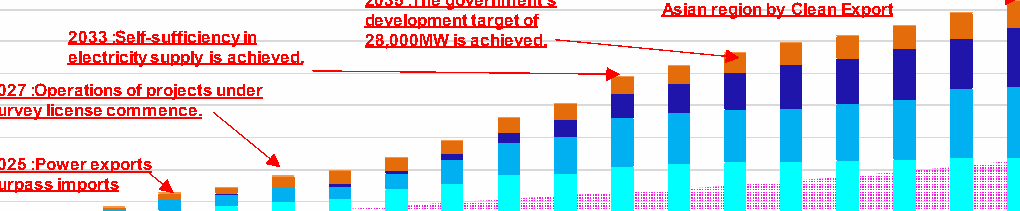
Figure 3.1-1 in MoEWRI IPSDP Executive Summary is the most compact official statement of Nepal's state-planning timeline from the current IPSDP. Its value to the wiki is not the exact plotted curve values, which are too compressed in the executive-summary figure to transcribe year by year with confidence, but the dated milestones and the named project buckets attached to each era.
Milestones the figure fixes explicitly
| Year | IPSDP statement | Why it matters |
|---|---|---|
| 2025 | Power exports surpass imports | Marks the crossover from historic importer framing to a net-export posture |
| 2033 | Self-sufficiency in electricity supply is achieved | The domestic-supply milestone arrives before the later regional-export framing |
| 2035 | The government's 28,000 MW development target is achieved | This is the core state capacity target the ladder keeps returning to |
| 2040 | Contribution to South Asian region by clean export | Export is framed as a later regional role, not the first milestone |
Era buckets shown on the ladder
| Window | Named generation projects called out in the figure |
|---|---|
| ~2025 | Rasuwagadhi, Sanjen, Upper Modi A, Rahughat, Upper Trishuli 3B, Madhya Bhotekoshi, Upper Trishuli-1, Arun 3 |
| 2026-2030 | Tanahu HEP, Tamor Storage, Madi Storage HEP, Manang Marsyangdi, Budhi Gandaki Ka, Bheri 4 HEP, Tila-1, Tila-2 |
| 2031-2035 | Lower Seti, Uttarganga STO, Phukot Karnali, Nalsyau Gad STO, Upper Arun, Chainpur Seti, Dudhkoshi STO, Sunkoshi 3 STO, Lower Badigad STO, Budhi Gandaki, Upper Marsyangdi-2, Dudh Koshi-IV, Upper Tamor, Bheri-2, West Seti STO, SR-06 STO |
| 2036-2040 | Betan Karnali, Kimathanka Arun, Bharbung, Mugu Karnali STO, Tamakoshi 3, Khimti Shivalaya STO, Bajhang Upper Seti, Naumure STO, Upper Mugu Karnali, Bheri-1, Humla Karnali Cascade |
What this page does and does not claim
- This page captures the dated milestones and named project groupings with high confidence from the figure itself.
- It does not yet claim a machine-ready year-by-year table of installed capacity, demand, and export values. Those traces need a higher-resolution source or manual chart digitization before they should be reused as numeric data.