Marsyangdi
- Page status
- Working page
- Updated
- 2026-05-11
Summary
69 MW · operating · on the Marsyangdi · in Gorkha district.
Specifications
| Parameter | Value |
|---|---|
| Capacity | 69 MW |
| Status | Operating |
| Registry licence | Operation |
| River | Marsyangdi (Gandaki Basin) |
| District | Gorkha |
| Province | Gandaki Pradesh |
Sources
- NEA Transmission Annual Book 2077
- NEA Annual Report FY 2024/25
- JICA IPSDP Final Report Annexes (Vol. 2)
Specifications (NEA FY 2081/82)
Marsyangdi is a peaking run-of-river plant — 4 hours of daily peaking capacity from 69 MW of installed generation across three Francis units. Commissioned in 1989, it has now operated for 36 years and accumulated over 15,000 GWh of lifetime generation.
| Parameter | Value |
|---|---|
| Type | Peaking run-of-river (PROR) |
| Units | 3 × Francis |
| Commissioning | 1989 |
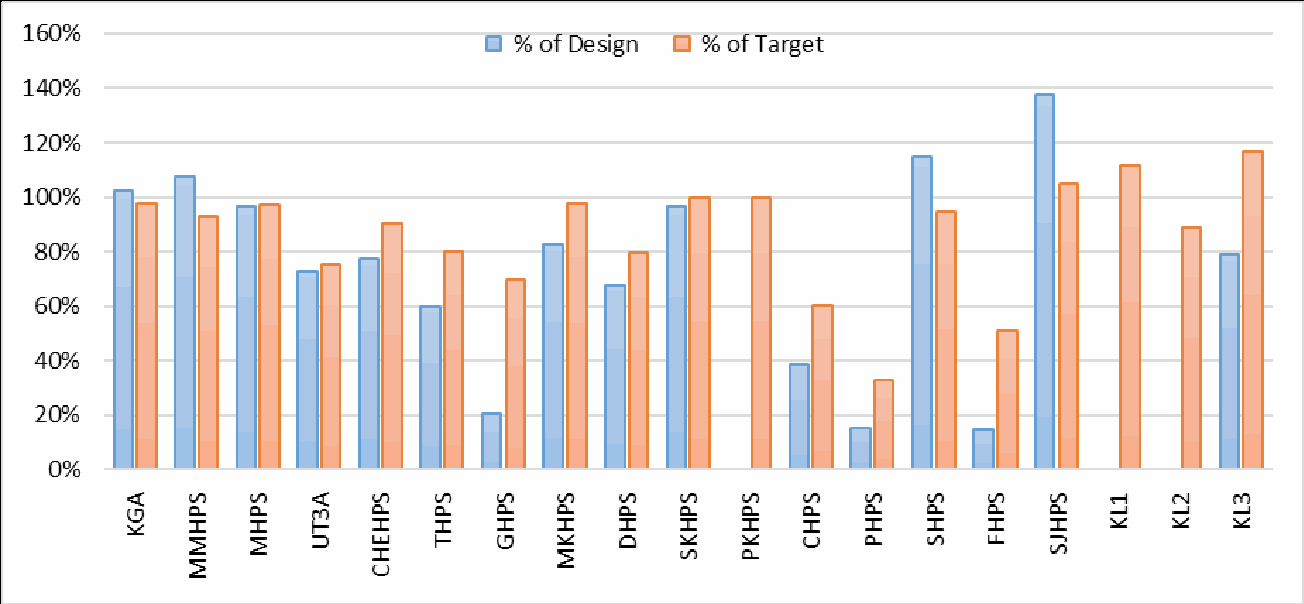
| Design generation | 462.5 GWh/yr |
| FY 2081/82 generation | 451.8 GWh |
| FY 2081/82 vs design | 97% |
| FY 2081/82 vs target | 97% |
| Year-over-year change | +1.28% |
| Cumulative lifetime generation | 15,046.929 GWh |
| District | Tanahun (not Gorkha — see correction note) |
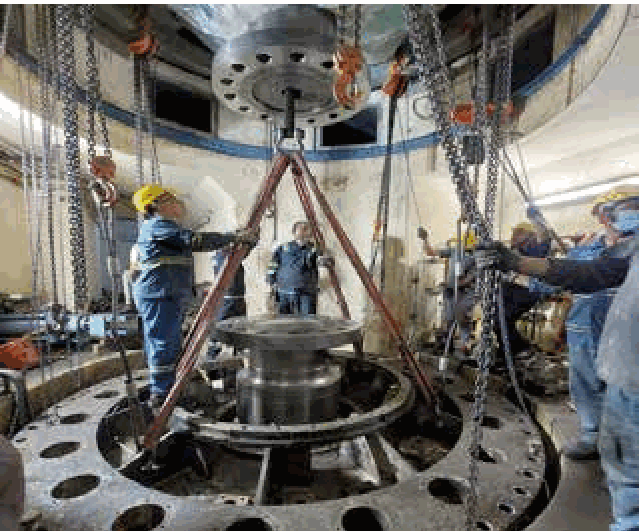
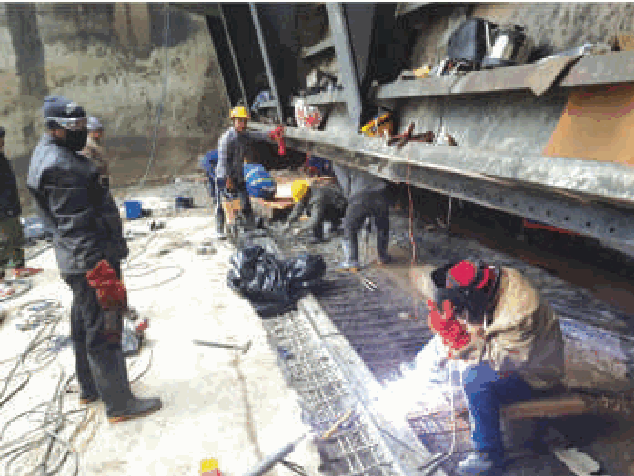
This fiscal year, Marsyangdi completed overhaul of Unit No. 2 and maintained key infrastructure including radial gates, desander basin floating boom, and gantry crane wire rope. Repairs were also performed on the hook block, shaft seal, and sliding ring of Unit No. 3.
Why Marsyangdi Matters — The Aging Fleet Benchmark
Marsyangdi is one of only a handful of NEA operating plants that actually hits its design numbers. At 97% of design generation (451.8 GWh against 462.5 GWh), it dramatically outperforms the median private IPP — where, as documented in Q-Design Discharge, zero of 100+ projects in a recent Urja Khabar audit exceeded 80% of contracted energy.
This makes Marsyangdi a critical reference point. If a 36-year-old NEA plant with 1980s turbine technology can achieve 97% of its design energy, the design-energy gap at newer private IPPs cannot be explained by hydrology alone. Something else — Q-design optimism, build-quality shortcuts, commissioning-phase derating, or the PPA structure itself — is driving the performance divergence. See Q-Design Discharge and Installed MW, Energy, Seasonality, and Firm Power Are Routinely Conflated.
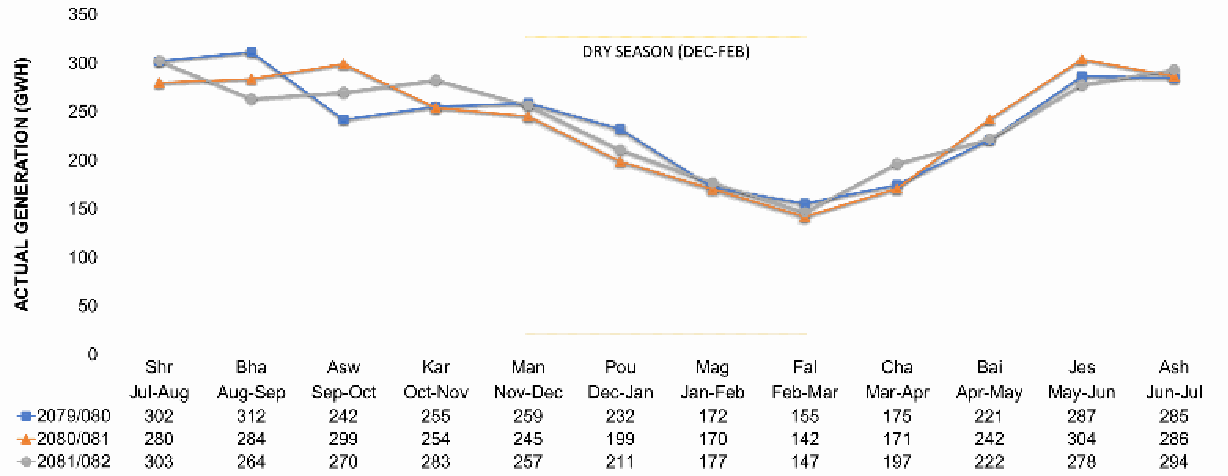
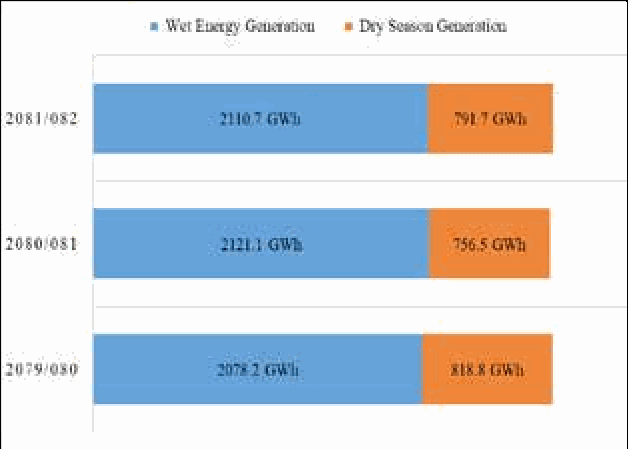
The seasonal generation charts visible in the NEA FY 2024/25 report images above confirm the pattern: even a plant that achieves 97% annually still undergoes the classic RoR seasonal collapse — monsoon surplus tapering to a fraction of nameplate in January–February. Marsyangdi cannot escape Seasonal Mismatch, regardless of its design-performance discipline.
Rehabilitation on the Horizon
At 36 years old, Marsyangdi is the second-oldest large NEA plant still in regular service (after Trishuli, commissioned 1967). The Unit 2 overhaul completed this fiscal year is routine — but the plant approaches an age where major rehabilitation becomes a binary question: invest in full electromechanical replacement or accept progressive derating.
The parallel is Kali Gandaki A (144 MW, commissioned 2002), where NEA floated a rehabilitation tender in 2024 to replace all three turbine runners after 22 years. Marsyangdi, at nearly double that age on the turbines, faces a larger decision. Every rehab of a fleet anchor plant introduces outage risk during dry season — precisely when the Storage Deficit exposure peaks.
The overhaul data from FY 2081/82 is an early signal: the maintenance scope is expanding. Radial gates, desander basin components, gantry crane wire rope, shaft seals — these are not routine wear items. They are the visible surface of an aging electromechanical fleet that NEA's capital budget will eventually need to confront at scale.
Limitations & Controversies
Aging fleet anchor. At 36 years, Marsyangdi is the second-oldest large NEA plant still in regular service. The Unit 2 overhaul completed in FY 2081/82 is routine, but the plant approaches an age where full electromechanical replacement becomes a binary decision. Every rehab introduces outage risk during dry season — precisely when Storage Deficit exposure peaks.
Registry data error. The Ministry of Energy registry lists the district as Gorkha; the NEA FY 2024/25 report places Marsyangdi in Tanahun. The map data currently reflects the registry; this remains a reconciliation item. This kind of slug-location mismatch is a recurring data-quality issue across NEA's multi-source reporting.
Non-replicable performance context. Marsyangdi's 97% of design energy is exceptional against the private IPP baseline, but it was built as an NEA plant in the 1980s with conservative Q-design, pre-climate-shift hydrology, and sovereign financing. The conditions that produced this performance are not replicable for modern private IPPs operating under the current PPA regime.
Cannot escape seasonal mismatch. Even at 97% annual performance, Marsyangdi undergoes the classic RoR seasonal collapse — monsoon surplus tapering to a fraction of nameplate in January–February. The plant is a benchmark for design discipline, not a solution to Seasonal Mismatch.
See also
- Kali Gandaki A — the next aging fleet anchor, now entering rehab
- Q-Design Discharge — why Marsyangdi's 97% is striking against the IPP baseline
- Seasonal Mismatch — the structural problem even a well-run RoR cannot solve
- Installed MW, Energy, Seasonality, and Firm Power Are Routinely Conflated — nameplate vs delivered energy
- Gandaki Basin — basin context; the Marsyangdi cascade feeds the Narayani
- Run-of-River Hydropower