Buildability
- Page status
- Verified core
- Updated
- 2026-11-04
- Last reviewed
- 2026-11-04
- Review due
- 2027-02-04
Summary
Buildability is the first-order filter on Nepal’s hydropower future: a project is not “good” because a desk study assigns a large MW number—it is good if the entire delivery package remains credible after geology, hydraulics, hazards, and grid realities are stressed.
Simple Explanation
Buildability asks: can this project actually be built and operated, given Nepal's mountains, earthquakes, sediment, and thin construction market? A project that looks good on paper may fail because the tunnel collapses, the turbines wear out in months from silt, or the transmission line to evacuate the power never gets built.
The schedule record
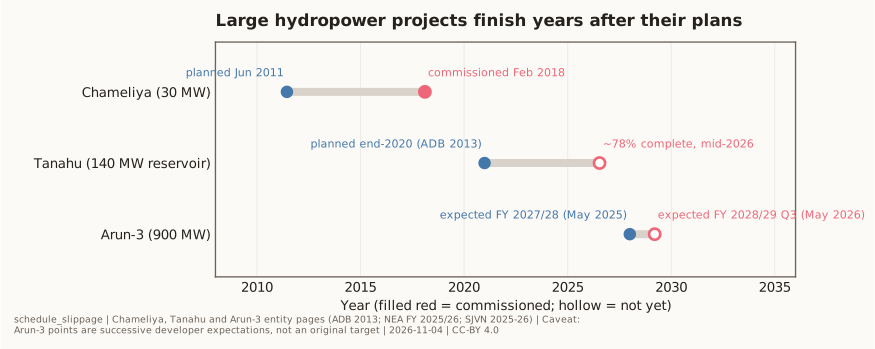
Nepal's large projects finish years after their plans. The gap is not a forecasting error on one project; it is the normal outcome of building in this terrain and institutional setting.
| Project | Plan | Outcome or latest status |
|---|---|---|
| Chameliya Hydropower (30 MW) | Civil works from 2007; COD targeted for June 2011 | Commissioned 10 February 2018, after a headrace tunnel collapse; about USD 7.5 million per MW |
| Upper Tamakoshi (456 MW) | National-priority run-of-river project | Commissioned in August 2021 after an 11-year construction period |
| Tanahu Hydropower Project (140 MW reservoir) | ADB's 2013 appraisal estimated completion by end-2020 | About 78% complete in mid-2026; the first headworks contract was terminated and every bid in the next round rejected; ADB's loan closing moved from June 2021 to December 2028 (NEA Annual Report FY 2025/26, ADB Tanahu Hydropower Project Documents (2026)) |
| Arun 3 (900 MW) | SJVN expected commissioning in FY 2027/28 (May 2025) | Expectation moved to FY 2028/29 Q3 in May 2026 |
| Budhigandaki Hydroelectric Project (1,200 MW reservoir) | Decades of planning | Preparatory works tendered in 2026; main construction contract planned from January 2028 |
Delay is not only a calendar problem; it changes the finances. Upper Tamakoshi's power purchase tariff (NPR 3.74 wet / 6.96 dry per kWh) was set when its capital structure was modelled at 75:25 debt to equity. By commissioning it was 88:12, after interest during construction, earthquake repairs and contractor delays, and the tariff was never adjusted (Upper Tamakoshi). The cost of slippage lands on the project's balance sheet, and through debt service on its ability to perform.
A credible plan therefore treats announced completion dates as dated expectations, not facts, and asks what has to happen, in what order, before each date is reachable.
What buildability actually tests
A serious buildability review chains interdependent risks:
- Geology and underground works — tunneling and cavern stability under high cover, fault zones, and variable rock mass ratings.
- Sediment and abrasion — turbine technology, wear life, and maintenance cycles are not O&M trivia when concentrations swing orders of magnitude seasonally (see Sediment as Design Constraint).
- Hydraulic transients and flood/GLOF exposure — hazard tolerance and intake resilience.
- Evacuation — generation without Stranded Generation-grade transmission is incomplete infrastructure. See the Likhu cascade: four private IPPs totaling 213 MW commissioned into a New Khimti substation sized for half their output, stranding ~40% of contracted generation in FY 2023/24 until a 200 MVA transformer upgrade restored the corridor.
- Execution realism — contractor capacity, local logistics winter, and financing covenants that survive delay. See Chameliya (11-year build, $7.5M/MW, headrace tunnel collapse) and Upper Trishuli 3A (2024 flood destroyed gates and control room, 88-day outage at Upper Tamakoshi).
Why storage is the hardest test
A run-of-river project can usually be licensed, financed and built as one package by one developer. A reservoir cannot. Before it earns anything, it needs a large land take and resettlement, environmental and social safeguards at the highest risk category, a dam designed for sediment and earthquakes, transmission to evacuate peaking output, and financing that survives a decade of construction. Dudhkoshi's safeguards are classified Category A, high risk, with resettlement, Indigenous Peoples, biodiversity and dam-safety instruments still under preparation in February 2026 (Dudhkoshi Storage Hydroelectric Project). Every one of those strands has to hold at the same time, for years.
That is why the Storage Deficit persists even though storage is the clearest physical answer to Seasonal Mismatch. The binding constraint is not knowing what to build. It is keeping a coalition of ministries, lenders, contractors, communities and grid planners aligned long enough to build it.
Hazards after commissioning
Buildability does not end at commissioning. The September 2024 floods and landslides affected operating projects with more than 600 MW of combined capacity (World Bank Nepal Country Economic Memorandum (2025)). On the Rasuwa Bhote Koshi–Trishuli corridor, a July 2025 glacial-lake outburst and the 26 August 2026 avalanche flood washed away the 111 MW Rasuwagadhi plant and buried access to Upper Trishuli 3A's underground powerhouse (Bhotekoshi–Trishuli Flood 2026). A project that is buildable on historical hydrology may not be operable on future hydrology (GLOF Risk, Q-Design Discharge).
Transmission is part of the project
A plant is not finished until its power can leave. The Likhu cascade commissioned into a substation sized for half its output. On the national 400 kV backbone, a right-of-way dispute held up the Hetauda–Dhalkebar section for about a decade, limiting transfer to about 300 MW against a design of about 2,000 MW until the dispute was resolved in 2026 (Hetauda–Dhalkebar–Inaruwa 400 kV Backbone). NEA's FY 2025/26 report says the new Markichowk–Bharatpur 220 kV line finally lets Marsyangdi-basin plants evacuate at rated capacity (NEA Annual Report FY 2025/26, PDF p.13). Generation and transmission have to be planned and delivered as one system.
Strategic implication
The planning-relevant metric is therefore system value — incremental dependable energy, loss factors, curtailment risk, and delivered cost — rather than headline megawatts. That reframing connects naturally to Storage Deficit (seasonal re-timing is worthless if the dam never reaches COD) and to basin-scale complexity in Karnali Basin megaproject corridors.
Megaprojects such as Budhigandaki Hydroelectric Project are instructive case files: the controversy is not only "how big," but whether the integrated package of reservoir, tunnels, communities, and finance can survive the decades-long path to operation. At the opposite scale, Marsyangdi (69 MW, 36 years old) demonstrates that aging units approaching overhaul age carry a different buildability risk. Khimti-I (60 MW, 1996) proves what an early-generation negotiated PPA can deliver, while Likhu-4 (120→52 MW redesign after India wheeling dispute) shows buildability includes the regulatory environment the project commissions into.
The portfolio lesson follows from the schedule record. When most of a plan depends on a few large projects that share the same risks, such as one corridor, one contractor market or one financing window, a single delay moves the whole plan. A portfolio that mixes short-cycle resources, such as substation-adjacent solar (Substation-Adjacent Solar Can Offer a Shorter Development Cycle, medium confidence) and batteries, with a small number of carefully prepared reservoirs spreads that risk. Sequencing matters as much as selection: the transmission and substations a project needs should be finished before it, not after it.
Questions a buildability review should ask
- Geology: what share of tunnelling and underground works is in poor or uncertain rock, and what is the contingency?
- Sediment: what concentrations does the design assume, and how will turbines and the reservoir be protected?
- Hazard: has the design been checked against glacial-lake, landslide-dam and extreme-flood scenarios, not just historical floods?
- Evacuation: is the line and substation that will carry the power funded, permitted and scheduled to finish first?
- Land and people: is resettlement planned, budgeted and agreed with the affected communities?
- Finance: do the financing terms survive a three- to five-year delay?
- Institutions: which agencies must act, in what order, and who is accountable for each step?
- Climate: has the design discharge been rechecked against recent hydrology, and what happens to contracted energy and debt service if flows shift (Q-Design Discharge)?
Common Misunderstandings
- "Licensed = buildable" — many licensed projects stall for years due to financing, geology, or grid constraints. A license is a permit, not a construction guarantee.
- "Buildability is just engineering" — it includes social acceptance, financing, regulatory environment, and market access.
- "Big projects are inherently better" — megaprojects concentrate risk; a portfolio of smaller, buildable projects may deliver more system value.
What would change our mind
- Several large projects, especially reservoirs, reaching commissioning close to their appraised schedule and cost.
- Evidence that recent reforms, such as the 2082 reservoir directive or open access, are shortening the path from licence to construction.
- A transmission programme that consistently finishes ahead of the generation it serves.
Related
- Sediment as Design Constraint — the turbine-wear dimension
- Stranded Generation — when buildable generation cannot be monetized
- Storage Deficit — re-timing is worthless if the dam never reaches COD
- Karnali Basin — basin-scale megaproject complexity
- Budhigandaki Hydroelectric Project — the largest buildability test case
- Governance Weakness Wastes Hydro Opportunity Through Delays and Misaligned Incentives — institutional failures as binding constraint
Sources
- WECS Assessment of Hydropower Potential of Nepal (2019)
- ADB Hydropower Growth Nepal Study
- World Bank Nepal Power-Sector Evidence Record (2018–2025)
- NEA Annual Report FY 2025/26
- ADB Tanahu Hydropower Project Documents (2026)
- World Bank Nepal Country Economic Memorandum (2025)
Update history
| Date | Change |
|---|---|
| 2026-11-04 | Added the schedule record and exhibit, the storage test, post-commissioning hazards, transmission, a review checklist and conditions for revision |
| 2026-05-10 | Likhu, Chameliya and Upper Trishuli 3A examples |
| 2026-04-14 | Created |