Storage Deficit
- Page status
- Verified core
- Updated
- 2026-11-04
- Last reviewed
- 2026-11-04
- Review due
- 2027-02-04
Summary
Nepal’s energy crisis is often narrated as a shortage of projects. At the water–energy interface, the sharper truth is often a shortage of seasonal inventory: storage deficit—the gap between the impoundment capacity needed to re-time monsoon water to dry-season scarcity and what actually exists on the ground.
In FY 2025/26 Nepal's only operating reservoir cascade, Kulekhani, generated 92 GWh across the year, while Nepal imported 1,155 GWh, most of it between Poush and Chaitra (NEA Annual Report FY 2025/26, PDF pp.175–176). The gap between those two numbers is the storage deficit in its plainest form.
Simple Explanation
Nepal gets most of its river water in the monsoon but needs electricity year-round. Storage means holding monsoon water in reservoirs to release it in dry months. Nepal has almost none compared to other countries, so even though it has lots of rivers, it cannot shift energy from wet to dry season.
Run-of-river hydro and dry-season deficit
This is why adding more run-of-river hydro can worsen the dry-season deficit if the new MW arrives mainly in monsoon months and does not create storage or firm winter capacity. In the Department of Electricity Development's July 2026 register, Kulekhani's 106 MW is 2.71% of 3,909.721 MW of operating hydropower (Hydropower Fleet Composition); everything else either follows the river or shifts water within a day (Operating Fleet Is Overwhelmingly RoR/PRoR, Not True Storage, PRoR Is Not Seasonal Storage).
What the dry season asks of storage
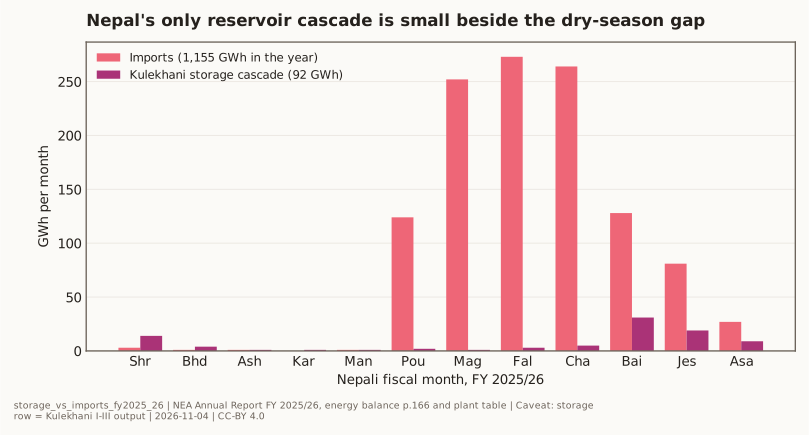
NEA's plant table shows Kulekhani I, II and III generating 53.0, 26.4 and 12.9 GWh in FY 2025/26, which together equal the energy balance's storage row. Kulekhani I's output was highest in Baishakh (19.0 GWh) and Jestha (11.5 GWh), just before the monsoon, and lowest from Ashwin to Mangshir. The reservoir is operated as a pre-monsoon and peaking reserve. It is far too small to carry the Poush–Chaitra deficit, when imports ran at 124–273 GWh a month.
The scale of the requirement is better stated in planning terms. Planning estimates put the storage hydropower Nepal needs by 2032 at 1,993 MW in a business-as-usual case and 3,154 MW with higher demand, against 106 MW operating today (Storage Capacity Comparison).
Orders of magnitude
International comparisons are sobering: Nepal is frequently placed around ~5 m³ per person of storage, versus rough reference magnitudes such as India ~180, China ~664, Norway ~15,100 (see Storage Capacity Comparison for the project table and caveats). Nepal's operational hydropower storage is essentially Kulekhani Cascade — three plants totaling 106 MW (Kulekhani I 60 MW reservoir, II 32 MW cascade, III 14 MW tail-end) with original storage volume of 85.3 MCM (JICA Storage Master Plan, 2014). Cumulative sediment deposition reached 25.3 MCM by 2010 (30% loss). Post-2010 DGPS bathymetric surveys (Sangroula, NTNU/Hydro-Lab, 2009/2010) measured
20.4 MCM total gross storage loss (23.9%) and 14 MCM active live storage loss
(19.1%). Separate InVEST/RUSLE spatial catchment modeling (Bokan et al., 2021–2024)
tracked a declining watershed sediment delivery rate from 13.3 t/ha/yr (2002) to
4.8 t/ha/yr (2018) due to watershed management, but the cumulative loss is
irreversible. The "106 MW of storage" claim therefore overstates the system's actual
seasonal-shifting capability — effective live storage is likely **59 MCM** and
still declining.
World Bank water diagnostics have framed multi-decadal storage needs at extraordinary volumes—on the order of 29.86 km³ in one national diagnostic framing—while noting that effective seasonal storage for that purpose is effectively absent. Whether one takes that headline literally or as an order-of-magnitude provocation, the ratio implies something like a ~200× mismatch between aspirational storage need and operational reality: the exact factor matters less than the sign—Nepal is storage-poor in both water security and power-firming terms.
Solar changes the storage job
Solar's Role in the Winter Deficit adds an important correction: not every dry-season kWh must come from reservoir water. Utility solar can supply a meaningful share of winter daytime energy faster and cheaper than new storage hydro. The storage deficit therefore splits into two problems:
- Seasonal inventory — water storage that shifts monsoon energy into dry months.
- Daily shifting — reservoir peaking, BESS, and demand response that move mid-day solar into the winter evening peak.
This makes storage no less important, but it makes a hydro-only storage story too narrow. Nepal still needs reservoirs where they are buildable; it also needs BESS and dispatch design so winter solar becomes firm enough to matter after sunset.
Topography as paradox
Nepal’s steep gradients are good for head and therefore for RoR hydropower, but narrow V-shaped valleys work against large gentle reservoirs at acceptable inundation. The contrast with classic big-basin storage (e.g., Aswan-scale volumes from modest dam heights) is instructive: Nepal can get “big numbers” on paper from river energy, yet struggle to find low-loss, low-conflict reservoir geometries—see discussions around Budhigandaki Hydroelectric Project and Dudhkoshi Storage Hydroelectric Project.
Why storage is politically hard even when physically “obvious”
Seasonal mismatch (Seasonal Mismatch) makes storage the clearest physical answer for evening and multi-week scarcity, but projects collide with sedimentation, seismic hazard, resettlement, financing, and treaty-dependent downstream politics. That is why Buildability matters as much as MW: a reservoir is not a line on a map until the whole engineering–social–finance package survives scrutiny. Tanahu (140 MW, about 78% complete in the NEA FY 2025/26 report) is the test case for whether Nepal can deliver a reservoir at all — and Kulekhani's ~24% gross / ~19% live sedimentation loss is the warning for what happens after commissioning.
The pipeline
| Project | Type | Status (latest evidence) |
|---|---|---|
| Tanahu Hydropower Project (140 MW) | Reservoir | About 78% complete in mid-2026; ADB's 2013 appraisal had estimated completion by end-2020 (NEA Annual Report FY 2025/26) |
| Dudhkoshi Storage Hydroelectric Project (670 MW) | Reservoir with dam-toe plant | Design and safeguard studies with ADB; USD 200 million AIIB financing still listed as proposed in November 2026 (AIIB Dudhkoshi Storage Hydroelectric Project Summary (2026)) |
| Budhigandaki Hydroelectric Project (1,200 MW) | Reservoir | Preparatory works tendered in 2026; main construction contract planned from January 2028 |
| Kulekhani Cascade (106 MW) | Operating reservoir cascade | About 24% of gross storage lost to sediment by 2009/10 surveys |
On these timelines, Tanahu is the only new reservoir likely to operate before the end of the decade. Dudhkoshi and Budhigandaki are 2030s projects at best (Buildability).
A ladder of durations
Storage is not one product. Each tool shifts energy over a different period:
| Duration | Tools in Nepal | What it solves |
|---|---|---|
| Hours | Peaking run-of-river pondage; batteries; demand response | Moving daytime or night energy into the evening peak |
| Days to weeks | Larger pondage; flexible imports | Smoothing short dry spells and outages |
| Months | Seasonal reservoirs | Carrying monsoon water into Poush–Chaitra |
Peaking plants such as Kali Gandaki A provide about six hours of daily peaking (Kali Gandaki A). That is valuable for the evening, but it does not move water from Bhadra to Falgun. Solar raises the value of the hours rung by producing in daylight. It leaves the months rung to reservoirs, imports or demand that shifts with the seasons.
Paying for storage
Storage is hard to finance under contracts that pay for energy alone. The standard tariff pays per kWh generated, with a dry-season premium (PPA Pricing). A reservoir's main product is different: capacity kept available at a named time. The Electricity Regulatory Commission's 2082 reservoir directive distinguishes monthly contract energy from capacity declared and kept available for named periods (ERC Reservoir-Based Generating Station Electricity Purchase and Sale Directive 2082). Whether that framework attracts finance and survives contact with real projects has not yet been tested.
Common Misunderstandings
- "More dams automatically solve the problem" — Nepal's narrow V-shaped valleys make large reservoirs hard to build. Storage is physically obvious but geologically and socially constrained.
- "Storage means more total energy" — storage re-times energy; it does not create new energy. The monsoon inflow is the same with or without a dam.
- "Kulekhani proves Nepal can build storage" — Kulekhani is small (60 MW + cascade) and has lost ~24% of gross storage to sediment. It is the exception that proves the scale of the gap, not a template for replication.
What would change our mind
- Evidence that dry-season imports can be eliminated for several years through solar, batteries and demand shifting alone, without new seasonal storage.
- A reservoir delivered close to its appraised schedule and cost, which would weaken the claim that storage is the hardest thing to build.
- Updated sediment surveys showing that Kulekhani or future reservoirs lose storage far more slowly than the 2009/10 surveys imply.
Related
- Seasonal Mismatch — the problem storage addresses
- Firm Power — what storage actually delivers
- Budhigandaki Hydroelectric Project — the largest proposed reservoir
- Dudhkoshi Storage Hydroelectric Project — multi-basin storage concept
- Storage Capacity Comparison — international storage comparison table
- Kulekhani Cascade — Nepal's only operational storage
Sources
- World Bank Nepal Water Sector Diagnostic
- National Water Plan, Nepal
- NEA Annual Report FY 2025/26
- NEA Annual Report FY 2024/25
Update history
| Date | Change |
|---|---|
| 2026-11-04 | Added FY 2025/26 storage-versus-imports evidence and exhibit, the reservoir pipeline, the duration ladder, the 2082 directive and conditions for revision |
| 2026-05-21 | Kulekhani sedimentation and solar-correction sections |
| 2026-04-14 | Created |