Upper Tamakoshi
A 456 MW operating peaking run-of-river project tracked through company disclosures, with financial recovery and expansion milestones kept separate.
- Page status
- Working page
- Updated
- 2026-07-13
- Last reviewed
- 2026-11-04
- Review due
- 2027-02-04
Summary
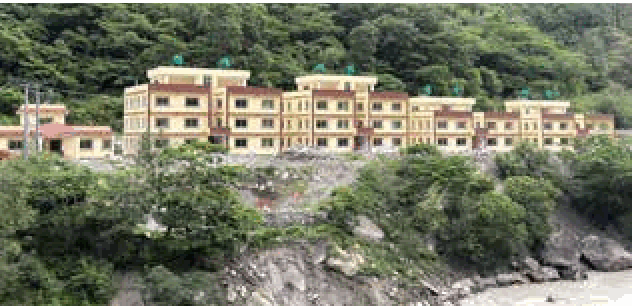
Nepal's largest operating hydropower plant at 456 MW. Located on the Tama Koshi River in Dolakha district. Commissioned in 2021.
Current Status and Performance Provenance
As of 10 July 2026: operating. UTKHPL published combined annual reports for FY 2079/80 and 2080/81 in April 2026 and its FY 2082/83 third-quarter financial report in May 2026. Those company disclosures are the current evidence base for operations, debt, insurance recovery and shareholder monitoring; older research compilations should not be treated as the final word when a newer filing differs.
| Dimension | Current position | Evidence |
|---|---|---|
| Delivery | Operating; 456 MW | Structured project registry and UTKHPL disclosures |
| Financial reporting | Third-quarter FY 2082/83 report published | 13 May 2026 |
| Annual reporting | FY 2079/80 and FY 2080/81 annual reports published | 6 Apr 2026 |
| Expansion | Rolwaling diversion milestone and contribution require current project-company verification | Monitoring gap |
Recent Updates
| Date | Update | Source |
|---|---|---|
| 13 May 2026 | FY 2082/83 third-quarter financial report published | UTKHPL project updates |
| 6 Apr 2026 | Sixteenth and seventeenth annual reports published | UTKHPL annual reports |
Active Blockers
| Blocker | Prevents | Current handling |
|---|---|---|
| Financial recovery and insurance/debt reconciliation remain filing-dependent | A stable forward financial assessment | Update from company and rating disclosures, not secondary summaries |
| Rolwaling diversion schedule, cost and incremental energy lack a current milestone record in the wiki | Reliable expansion forecast | Keep the milestone explicitly unverified until a primary update is ingested |
Specifications
| Parameter | Value |
|---|---|
| Capacity | 456 MW |
| Status | Operating |
| River | Tama Koshi (eastern Koshi Basin) |
| District | Dolakha |
Engineering
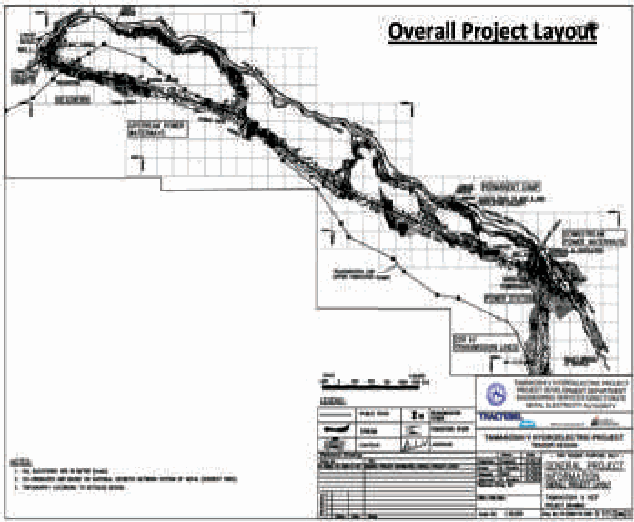
With 822 m of gross head — among the highest in Nepal — Upper Tamakoshi concentrates one of the steepest river drops in the country through tunnels and penstocks to an underground powerhouse. This is the engineering archetype of Nepal's dominant hydro form: high-head diversion with no significant dam. See Run-of-River Hydropower.
| Parameter | Value |
|---|---|
| Gross head | 822 m |
| Headrace tunnel | 7.2 km |
| Underground powerhouse | Yes |
| Type | Run-of-River |
Output
Upper Tamakoshi's 2,281 GWh/yr design energy and 65% plant load factor set the benchmark for Nepal's RoR fleet. But actual generation has tracked below contracted levels — water flow in Spring 2023 collapsed to 45.12% of historical hydrological expectations, an example of the gap between design hydrology and operational reality explored in Q-Design Discharge.
| Parameter | Value |
|---|---|
| Annual design energy | 2,281 GWh |
| Plant load factor | 65 % |
Financial
Built at NPR 87–89 billion (~NPR 196 million/MW), financed with an effective 88:12 debt-to-equity ratio at COD (original 75:25 model was overwhelmed by NPR ~14 billion in Interest During Construction). First-year PPA at NPR 3.74/kWh wet and NPR 6.96/kWh dry — among the lowest tariffs in the sector. The structural gap between these rates and the project's debt service is the core of the NEA Triple-Authority Conflict problem. See the Financial Performance section below for the detailed breakdown.
| Parameter | Value |
|---|---|
| PPA rate (wet) | NPR 3.74/kWh |
| PPA rate (dry) | NPR 6.96/kWh |
| Debt/equity | 75/25 |
Schedule
Commissioned in 2021 after roughly seven years of construction, Upper Tamakoshi was the plant that broke Nepal's load-shedding era. Compare with Chameliya Hydropower — a 30 MW project that took 11 years — for a case study in execution risk.
| Parameter | Value |
|---|---|
| Commercial operation | 2021 |
| Completion | 100 % |
Generation Performance (FY 2079/80 – 2081/82)
Three years of actual dispatch data now confirm that Upper Tamakoshi's turbines and hydrology are broadly performing as designed — the financial crisis is a balance-sheet problem, not an engineering one.
| Fiscal Year | Contracted (GWh) | Actual (GWh) | % of Contracted | Context |
|---|---|---|---|---|
| FY 2079/80 | 2,281 | 1,945.83 | 85.3% | First stable operating year |
| FY 2080/81 | 2,281 | 2,058.36 | 90.2% | Peak production — best year to date |
| FY 2081/82 | 2,281 | 1,529.07 | 67.0% | 88-day forced shutdown (Sep 2024 flood) |
Source: UKHLL audited accounts; NEA Annual Report FY 2081/82; ICRA Nepal credit assessments.
FY 2080/81 — The Analytical Pivot
The 90.2% generation in FY 2080/81 is the single most important data point in understanding Upper Tamakoshi. A run-of-river plant achieving 90% of contracted energy is performing exceptionally well by any regional standard. The Tamakoshi basin hydrology was accurately mapped; the Q-design discharge (66 m³/s) reflects real river behaviour under normal conditions.
This result kills one version of the Upper Tamakoshi story — that it is a victim of hydrological forecasting error or Q-Design Discharge optimism. It is not. The turbines spin as designed when the river flows as modelled.
What it shows instead is that the financial distress is structurally inevitable even at near-peak generation. At 2,058 GWh and NPR 3.74/6.96 blended tariff, maximum gross revenue is approximately NPR 9.3–9.5 billion. Interest expense alone (~NPR 6.7 billion) consumes over 70% of that ceiling. Principal amortization takes most of the remainder. The company cannot break even at its contracted tariff even when the river cooperates.
FY 2081/82 — Climate Event, Not Structural Failure
In late September 2024 (Ashwin 2081), post-monsoon flooding caused catastrophic damage to the plant's surface civil structures:
- Left and right desander ponds severely compromised (critical for removing abrasive silt before water enters the Pelton turbines)
- Underground box culverts damaged
- Surface control rooms affected
- A critical 220 kV transmission tower destroyed, cutting grid evacuation
Electricity generation was entirely suspended for 88 days. Partial operations resumed in mid-January 2025 using only the repaired left desander pond — engineers accepted suboptimal single-desander operation rather than wait 45 more days for full reconstruction, knowing the financial cost of continued downtime.
Physical damage was assessed at approximately NPR 1.79 billion. Business interruption losses reached approximately NPR 1.43 billion. Total insurance claim submitted: NPR 2.0 billion — but the NPR 1.43 billion in business interruption losses are largely unrecoverable because the insurance policy's Loss of Profit (LOP) coverage explicitly excludes transmission infrastructure failures, and the destroyed 220 kV tower that cut grid evacuation was classified as a transmission asset rather than a generation asset.
Full dual-desander operations were not restored until mid-2025.
Significance
Upper Tamakoshi is the plant that broke Nepal's load-shedding era. At 456 MW, it represents ~16% of total installed hydro capacity and was the foundation of Nepal becoming a net power exporter in FY 2024/25 (NPR 17.47 billion in cross-border trade revenue).
It is also the archetype of Nepal's dominant engineering form: high-head diversion with no significant dam. The river drops 822 meters naturally; the engineering concentrates it through tunnels and penstocks to an underground powerhouse with six 76 MW Pelton turbines.
But the plant that ended load-shedding is now formally insolvent. Both facts are true simultaneously — and together they define the central tension in Nepal's energy sector.
Financial Performance
The Structural Mathematics of Default
Upper Tamakoshi was financed at what was modelled as a 75:25 debt-to-equity ratio. By commissioning in August 2021 — after an 11-year construction period interrupted by the 2015 Gorkha earthquake, border blockades, and COVID-19 — capitalized Interest During Construction (IDC) had swelled the debt burden to the point where the effective leverage ratio at COD was 88:12. The project was almost entirely debt-funded at the moment it started generating revenue.
| Metric | FY 2079/80 | FY 2080/81 | FY 2081/82 |
|---|---|---|---|
| Actual generation | 1,945.83 GWh | 2,058.36 GWh | 1,529.07 GWh |
| Total revenue | ~NPR 8.68 billion | ~NPR 9.3–9.5 billion | ~NPR 6.9 billion |
| Interest expense | ~NPR 6.68 billion | Insufficient coverage | Insufficient coverage |
| Net profit/(loss) | ~NPR (2.52) billion | ~NPR (1.39) billion | ~NPR (2.57) billion |
| Accumulated losses | — | — | NPR 12.18 billion |
| Total debt | ~NPR 78.6 billion | ~NPR 78.6 billion | Default |
| DSCR | <1.0x | <1.0x | <1.0x |
| ICRA rating | — | Distressed | D (Default) |
Source: FY 2079/80 audited accounts (UKHLL); ICRA Nepal credit assessments; ShareSansar Q4 FY 2081/82 disclosure.
The 100% Right Share — Too Late
In FY 2080/81, UKHLL undertook a 100% right share issuance, doubling paid-up capital from NPR 10.59 billion to NPR 21.18 billion. The intent was to use fresh equity to retire high-cost commercial debt and fund the Rolwaling diversion (see below). But the equity injection could not alter the fundamental arithmetic: interest expense alone exceeds what the PPA allows the plant to earn in most years.
When the September 2024 flood struck, the fresh equity had no buffer left. Missed loan payments within 30 days of the outage triggered ICRA Nepal to downgrade UKHLL to D — formal default. Shareholders who had just doubled their exposure held equity in an insolvent entity.
The Rolwaling Diversion — Current Delivery Status Unverified
UKHLL's only viable internal mechanism to improve its financial position is the Rolwaling Khola diversion (22 MW): infrastructure to redirect the adjacent Rolwaling river into the Upper Tamakoshi reservoir, adding approximately 212 GWh of annual energy and extending dry-season peaking capacity from 4 hours to 6 hours.
The dry-season energy matters disproportionately: at NPR 6.96/kWh versus NPR 3.74/kWh, an extra 212 GWh skewed toward the dry season could add NPR 1.2–1.5 billion in annual revenue. Whether that is sufficient to bring DSCR above 1.0x depends on the debt restructuring terms that accompany any resolution.
Limitations & Controversies
- Structural default at near-peak generation. UKHLL was downgraded to ICRA D (Default) in FY 2081/82 despite achieving 90.2% of contracted energy in FY 2080/81. The crisis is a tariff-debt mismatch, not an engineering failure. See NEA Triple-Authority Conflict and PPA Pricing for the structural analysis.
- September 2024 flood damage. 88-day forced shutdown, NPR 1.79 billion physical damage, NPR 1.43 billion business interruption. Insurance claim of NPR 2.0 billion remains unsettled as of May 2026 due to transmission-exclusion clauses. See Financial Performance section above for full detail.
- Rolwaling delivery status unverified. The latest company filing in the wiki reports capital work in progress but no package milestone, stop/restart date or commissioning schedule.
- Cascading systemic risk. Default forces domestic banks (EPF, CIT, commercial banks) to reclassify loans as NPAs; hardens hydropower insurance market; signals to foreign investors that current risk-allocation framework may be uninvestable for mega-projects.
Structural implication
The gap between revenue and debt service at Upper Tamakoshi is not a commissioning-phase issue that will resolve with time. At its current PPA rate — which is among the lowest in the sector — the project's revenue cannot cover its interest, let alone principal. To break even by year 15, estimates suggest it would require an effective tariff roughly 2–3 times higher than current levels. See PPA Pricing.
Upper Tamakoshi is the most prominent case of the structural dynamic explored in NEA Triple-Authority Conflict: NEA as regulator set the tariff framework; NEA as majority shareholder (41%) participated in the equity structure that got diluted; NEA as sole off-taker buys at rates that cannot service the debt. Three different roles, one institution, zero mechanism for the commercial interest to override the regulatory one.
The PPA tariff (NPR 3.74/6.96) was set in an era when the project's capital structure was modelled at 75:25. By commissioning, it was 88:12. The tariff was never adjusted. The entire cost escalation — IDC, earthquake repairs, contractor delays — was absorbed by the balance sheet. The off-taker's obligation was unchanged.
Broader systemic implications
The ICRA default downgrade to D has cascading effects:
Domestic banking system. UKHLL's debt is held by EPF, CIT, Rastriya Beema Sansthan, Nepal Telecom, and domestic commercial banks. A D rating forces these institutions to reclassify their UKHLL loans as non-performing assets (NPAs), eroding their own profitability and threatening yield distributions to ordinary Nepalese whose retirement savings sit in the EPF and CIT.
Future project financing. If Nepal's flagship 456 MW project — backed by the state utility, staffed by NEA's engineers, and celebrated as a triumph of domestic financing — cannot service its debt, commercial banks will demand higher equity contributions, punitive rates, or refuse syndication on future IPP mega-projects entirely.
Insurance market. The NPR 2–3 billion insurance claim hardened Nepal's hydropower insurance market. Future projects face higher premiums against a PPA structure that provides no pass-through for increased OPEX. Every rupee of premium increase deepens the cash-flow deficit that already threatens DSCR.
Export ambitions. Nepal's export targets require hundreds of billions in fresh capital. UKHLL's default signals to both domestic and foreign investors that the current risk-allocation framework — developer bears 100% of geological, hydrological, and construction delay risk at a non-escalating monopsony tariff — is uninvestable for complex mega-projects.
Related
- Run-of-River Hydropower — the architecture Upper Tamakoshi exemplifies
- Q-Design Discharge — why generation falls short of contracted energy
- NEA Triple-Authority Conflict — the institutional conflict at the root of the tariff problem
- PPA Pricing — the tariff structure that cannot service the debt
- GLOF Risk — the flood hazard that triggered the 2024 shutdown
- Buildability — execution risk in Nepal's hydro sector
- Kulekhani Cascade — Nepal's only operational storage, for contrast
- Tanahu Hydropower Project — another Nepali-developed project with different financing