Master Thesis
TransparentGov's argument that Nepal's electricity problem is timing, delivery and institutions, not a shortage of megawatts, traced through FY 2025/26 evidence.
- Page status
- Verified core
- Updated
- 2026-11-04
- Last reviewed
- 2026-11-04
- Review due
- 2027-02-04
Editorial synthesis — TransparentGov assessment. This page makes an argument from the linked evidence. It is not the neutral system baseline. Read State of Nepal's Electricity System first for dated facts, official targets and unresolved data gaps.
Nepal is not short of hydropower. It is short of electricity it can count on when the rivers are low, delivered where it is needed, under institutions that reward that service. Every year the system swings from surplus to deficit and back. The fleet, the grid, the contracts and the regulator were built for the surplus half of that cycle. The next phase of Nepal's electricity strategy should be judged by how much dependable dry-season power reaches users, not by how many megawatts are added.
The argument in brief
- The same system that exports in the monsoon imports in the dry season, even in a record net-export year.
- Installed megawatts, annual energy and dependable dry-season power are different quantities. Public debate routinely treats them as one.
- The fleet follows the river because the contracts and financing that built it paid for energy, not for readiness.
- Seasonal storage is the clearest physical answer, and the hardest thing Nepal has tried to build.
- Power that cannot be delivered has no value, and the grid has lagged generation.
- One institution buys most of the power, dispatches the grid and administers contract penalties, so incentives for a complete service are weak.
- Trade monetises surplus, but it runs through India and does not remove the winter deficit.
- Solar changes the dry-season arithmetic in daylight, not after sunset.
- Climate change raises the cost of designing for yesterday's rivers.
1. One year, two systems
In FY 2025/26 Nepal recorded its largest-ever net electricity exports: 2,794 GWh, four times the year before (NEA Annual Report FY 2025/26, PDF p.11). That headline hides a seasonal reversal. In Bhadra, at the monsoon peak, domestic generation was 1,991 GWh against national demand of 1,405 GWh, and Nepal exported 587 GWh. Six months later, in Falgun, generation had fallen to 801 GWh while demand was still 1,067 GWh. Nepal imported 273 GWh and exported 13 GWh (PDF p.176).
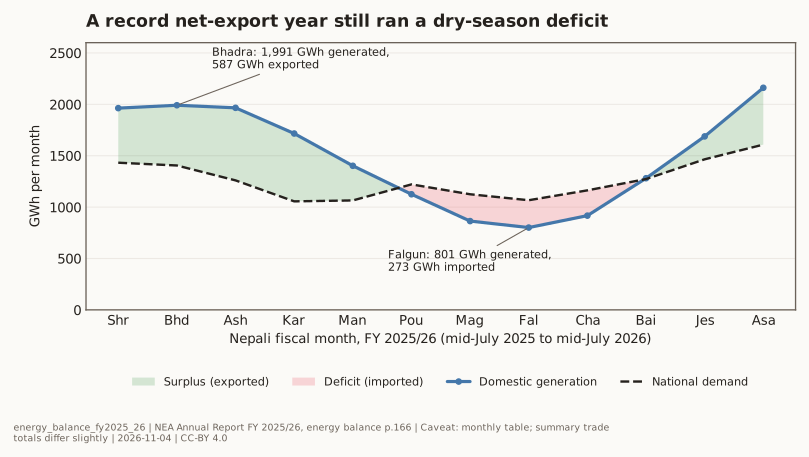
FY 2024/25 showed the same shape, with 1,848 GWh generated in Bhadra and 605 GWh in Falgun (NEA Annual Report FY 2024/25, p.134). This is not a drought or a bad year. It is the structure of a hydro system fed by monsoon rivers: basin models place roughly 67–78% of annual flow in June to September (WECS River Basin Plans and Hydropower Development Master Plan (2024)). See Seasonal Mismatch and Nepal's Core Hydro Problem Is Timing, Not Annual Volume (C-001, high confidence).
2. Megawatts are the wrong unit
The most quoted number in Nepal's energy debate is a hydropower "potential" of about 83,000 MW. WECS records that legacy figure as a theoretical estimate. Its 2019 assessment gives a gross potential of 72,544 MW and a techno-economic potential of 32,680 MW (WECS Assessment of Hydropower Potential of Nepal (2019)). None of these is a construction pipeline, and none says when the energy arrives.
Installed capacity has the same problem. NEA reported 4,120 MW at the end of FY 2025/26 (NEA Annual Report FY 2025/26, PDF p.185). National peak demand reached 2,479 MW. Yet in Falgun, domestic generation averaged only about 1,110 MW across the month.
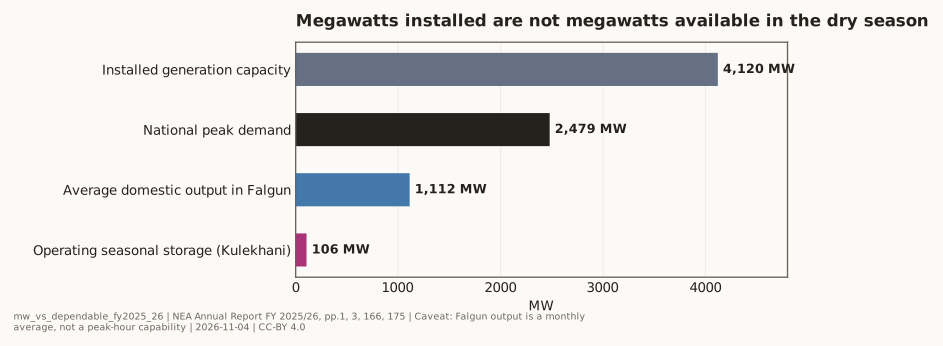
The question that matters is the one a system planner asks: how much power can be promised in a difficult dry-season hour, for how long, and delivered where? See Firm Power and Installed MW, Energy, Seasonality, and Firm Power Are Routinely Conflated (C-006, medium-high: the distinctions are documented; how often they are conflated has not been systematically sampled).
3. A fleet built to follow the river
Nepal's operating fleet is overwhelmingly run-of-river (RoR) and peaking run-of-river (PRoR). The World Bank describes more than 90% of hydropower as RoR or PRoR at end-2024 (World Bank Nepal Country Economic Memorandum (2025)). In the Department of Electricity Development's July 2026 register, the Kulekhani cascade, the only operating seasonal storage, is 106 MW of 3,909.721 MW, or 2.71% (Hydropower Fleet Composition). See Operating Fleet Is Overwhelmingly RoR/PRoR, Not True Storage (C-005, high).
Peaking plants are real flexibility, but on a daily clock. NEA describes the 144 MW Kali Gandaki A as a six-hour daily peaking plant (Kali Gandaki A). Six hours is not six months (PRoR Is Not Seasonal Storage, C-009, high).
The fleet looks like this because of what was easy to repeat. Private development opened in 1990 (WECS Assessment of Hydropower Potential of Nepal (2019)). By 2024 independent producers held 64% of installed hydro and supplied more than 70% of capacity added after 2018 (World Bank Nepal Country Economic Memorandum (2025)). Under the standard power purchase agreement, NEA's 2017 run-of-river tariff paid NPR 4.8 per kWh in the wet season and NPR 8.4 in the dry season (ERC/ECA Discussion Paper on Storage Hydro PPA Pricing (2025), Table 1): generate a unit, earn for that unit. A run-of-river project could be licensed, financed and built as one package. A reservoir needed government, lenders, builders and grid planners to keep land, safeguards, transmission and finance moving together for a decade.
This is not a verdict against run-of-river plants. They helped add the energy that ended scheduled load-shedding in 2018 and built a domestic development industry. The point is that the contracts paid for energy, so the market supplied energy. Seasonal readiness was nobody's product. See PPA Pricing and Nepal Fails on Conversion of Hydrological Advantage Into Deliverable Power (C-032, high).
4. Storage is the answer that is hardest to build
The clearest physical way to move monsoon water into the dry season is to store it (Storage Is the Clearest Physical Answer to Seasonal Mismatch, C-008, high). Nepal has almost none. The Kulekhani cascade generated 92 GWh in the whole of FY 2025/26, most of it in Baishakh and Jestha. Imports were 1,155 GWh, most of them from Poush to Chaitra (NEA Annual Report FY 2025/26, PDF pp.175–176). Surveys in 2009/10 found Kulekhani's reservoir had already lost about 24% of its gross storage to sediment since commissioning in 1982 (Storage Deficit, Kulekhani I).
Planning estimates of the storage hydropower Nepal needs by 2032 range from 1,993 MW to 3,154 MW (Storage Capacity Comparison). The projects that would supply it show how hard delivery is:
| Project | Plan | Status (latest evidence) |
|---|---|---|
| Tanahu Hydropower Project (140 MW) | ADB's 2013 appraisal estimated completion by end-2020 | About 78% complete in mid-2026 after a terminated headworks contract and a rejected re-tender (NEA Annual Report FY 2025/26) |
| Dudhkoshi Storage Hydroelectric Project (670 MW) | ADB-led financing with USD 200 million proposed by AIIB | Still "proposed" on AIIB's project page; design, safeguards and access roads advancing |
| Budhigandaki Hydroelectric Project (1,200 MW) | Government-led reservoir with its own development company | Camp and bridge works tendered in April 2026; main construction contract planned from January 2028 (Kantipur, 13 Apr 2026) |
A reservoir is not a larger run-of-river plant. It is a coalition that has to survive geology, resettlement, sediment, finance and politics for ten years before it earns anything. See Buildability.
5. Power has to arrive
Generation that cannot reach a load is worth nothing. NEA's own FY 2025/26 report says the new Markichowk–Bharatpur 220 kV line enables Marsyangdi-basin generators to evacuate power "at their rated capacity", implying they could not before, and names minimising generation curtailment as a challenge (NEA Annual Report FY 2025/26, PDF pp.12–13). On the Hetauda–Dhalkebar section of the national 400 kV backbone, transfer was limited to about 300 MW against about 2,000 MW once complete; the decade-long dispute was reported resolved, but energisation had not been confirmed by early November 2026 (Hetauda–Dhalkebar–Inaruwa 400 kV Backbone).
No public data allow a national curtailment total to be calculated. Plant-level availability and dispatch records are not published (Stranded Generation). That gap is itself a finding. See Transmission and Delivery Are Material Immediate Monetization Constraints (C-019, medium-high).
6. The buyer, the dispatcher and the judge
The Nepal Electricity Authority buys most of the country's electricity, dispatches the grid, administers availability-declaration penalties under its contracts, and owns power plants that compete with the producers it buys from (NEA Triple-Authority Conflict). Power purchases cost NEA NPR 96.1 billion in FY 2025/26, 65% of its NPR 148.6 billion energy-sales revenue, up 23.97% in a year (NEA Annual Report FY 2025/26, PDF p.13).
When one balance sheet carries the purchase obligations, the dispatch decisions and the penalty calls, every choice about who runs and who is curtailed is also a financial choice for the same institution. Reform has started. The Electricity Regulatory Commission issued an open-access directive in January 2026 and set the first national transmission charges for FY 2026/27. But the metering, settlement and grid-connectivity rules that would make open access work were still in draft in September 2026 (Governance Weakness Wastes Hydro Opportunity Through Delays and Misaligned Incentives, C-029, medium-high). See Decision Dossier — Power-System Role Separation and Open Access.
7. Trade monetises surplus; it does not cover the winter
Exports earned NPR 29.3 billion in FY 2025/26, about NPR 7.4 per kWh on NEA's summary totals; imports cost NPR 10.6 billion, about NPR 9.0 per kWh (NEA Annual Report FY 2025/26, PDF p.14). Nepal sells when power is plentiful and buys when it is scarce, so the timing works against it (Seasonal Arbitrage Trap).
Almost every export goes to India, through Indian power markets and bilateral agreements, and the cross-border limits (1,650 MW export and 1,400 MW import on the Dhalkebar corridors, approved in July 2026) are set by bilateral committees. Even the new 40 MW supply to Bangladesh crosses India's grid. India is the decisive market and corridor (India Is the Decisive External Actor in Nepal's Hydro Future, C-025, high). Trade is valuable and should grow. It is a way to sell surplus and buy shortfall, not a substitute for dependable domestic winter supply.
8. Solar helps in daylight, not after sunset
Solar is the first scalable resource whose seasonal profile helps rather than worsens the dry-season problem. Two years of World Bank/ESMAP measurements at Nepalgunj found useful irradiance in several hydro-weak months (World Bank ESMAP Nepal Solar and Wind Resource Measurement, Solar–Hydro Complementarity). Installed solar reached 154.94 MW in FY 2025/26, and NEA signed 49 solar PPAs totalling 675 MW in the year (Solar in Nepal's Electricity System).
Solar does not cover the winter evening peak. It shifts the storage problem from seasons toward hours: batteries, pondage and demand response to move midday energy into the evening (Solar's Role in the Winter Deficit). That makes solar a core part of the answer and makes storage of every duration more important, not less.
9. Climate raises the price of designing for yesterday
The Rasuwa Bhote Koshi–Trishuli corridor saw three damaging events in 26 months: the September 2024 floods, the July 2025 glacial-lake outburst and the August 2026 avalanche flood that washed away the 111 MW Rasuwagadhi plant (Bhotekoshi–Trishuli Flood 2026, GLOF Risk). Projects are designed on historical flow records (Q-Design Discharge). When the hydrology shifts, contracted energy, debt service and safety margins shift with it (Climate Change Increases Volatility and Resilience Risk, Not a Simple "More Water" Win, C-012, high).
What follows
The editorial implication is a change of question. Before choosing a technology, write the dry-season order: how much energy across the dry months, how much power in the risky hours, for how long, delivered where, and who carries the risk if it fails. Then fill it with five jobs:
- Reduce or move flexible demand, while protecting essential loads.
- Produce more where a resource is strong in the dry season, including solar.
- Shift energy in time: pondage and batteries across hours, reservoirs across months.
- Deliver it, by completing corridors and substations before they bind.
- Protect it, with reserves and contingency plans for defined failures.
Each job needs a named controller and an honest confidence level. The 2082 reservoir directive is a first step toward paying for readiness: it distinguishes monthly contract energy from capacity declared and kept available (ERC Reservoir-Based Generating Station Electricity Purchase and Sale Directive 2082). If what gets paid for shapes what gets built, more of Nepal's contracts should pay for dependable service. The ranked constraints are in Bottleneck Hierarchy; the phased programme is in Twenty-Year Strategy; the policy choices are compared in the Decision Dossiers and Policy Options.
What would change our mind
- A dependable-capacity number that closes the gap. If NEA or the regulator published a dry-season firm-capacity assessment showing domestic supply meeting the winter peak with reserves, the central diagnosis would weaken.
- Run-of-river that delivers in winter. Plant-level data showing the RoR fleet's dry-season output rising faster than demand, without imports, would challenge the storage argument.
- Storage built on schedule. Tanahu commissioning near its current estimate, and Dudhkoshi or Budhigandaki reaching financial close and construction without major slippage, would weaken the buildability concern.
- Delivery data that show no binding constraint. Published plant-level curtailment and dispatch records showing negligible spill would weaken the transmission argument.
- Imports that disappear. A full dry season with no net imports and no load-shedding, achieved without reservoir storage, would require rethinking the thesis.
What the thesis is not
- It is not "Nepal has no hydropower potential". The resource base is real.
- It is not "stop building run-of-river". Nepal needs more generation, plus the right mix of storage, solar and demand.
- It is not "exports are bad". Exports are how surplus becomes revenue.
- It is not "India is the obstacle". India is the decisive market and corridor, and Nepal's strategy has to work through that.
- It is not a forecast. It is a diagnosis with stated confidence and stated conditions for revision.
Evidence trail
| Step | Claim | Confidence | Main evidence |
|---|---|---|---|
| Seasonal reversal | Nepal's Core Hydro Problem Is Timing, Not Annual Volume (C-001) | High | NEA FY 2025/26 and FY 2024/25 energy balances |
| Wrong unit | Installed MW, Energy, Seasonality, and Firm Power Are Routinely Conflated (C-006) | Medium-high | WECS 2019; NEA; DoED register |
| River-following fleet | Operating Fleet Is Overwhelmingly RoR/PRoR, Not True Storage (C-005) | High | World Bank CEM 2025; ERC/ECA 2025; DoED register |
| Daily is not seasonal | PRoR Is Not Seasonal Storage (C-009) | High | NEA plant descriptions |
| Storage as physical fix | Storage Is the Clearest Physical Answer to Seasonal Mismatch (C-008) | High | NEA balance; storage planning estimates |
| Delivery | Transmission and Delivery Are Material Immediate Monetization Constraints (C-019) | Medium-high | NEA FY 2025/26; Hetauda–Dhalkebar reporting |
| Institutions | Governance Weakness Wastes Hydro Opportunity Through Delays and Misaligned Incentives (C-029) | Medium-high | NEA finances; ERC open-access rules |
| India | India Is the Decisive External Actor in Nepal's Hydro Future (C-025) | High | NEA trade channels and bilateral limits |
| Climate | Climate Change Increases Volatility and Resilience Risk, Not a Simple "More Water" Win (C-012) | High | Flood record; Q-design methods |
| Integrated diagnosis | Nepal Fails on Conversion of Hydrological Advantage Into Deliverable Power (C-032) | High | All of the above |
Open questions
- What is Nepal's dependable dry-season capacity under a stated hydrology and reliability test? It is not published.
- How much generation is curtailed, where and why? Plant-level dispatch and availability data are not public.
- Why did Kulekhani's output fall by two-thirds, from about 280 GWh in FY 2024/25 to 92 GWh in FY 2025/26? Both figures come from NEA's energy balances; the FY 2025/26 report mentions automation works at Kulekhani I and II but does not explain the drop (Unresolved Questions).
- How will the reservoir directive and open-access rules change what gets built? Neither has a project-level track record yet.
Reading paths
- Five minutes: this page → Seasonal Mismatch → Firm Power.
- The evidence: State of Nepal's Electricity System → NEA Annual Report FY 2025/26 → Hydropower Fleet Composition.
- The options: Bottleneck Hierarchy → Twenty-Year Strategy → Decision Dossiers and Policy Options.
- The film: Film Evidence: Nepal Has Hydropower. Why Isn't It Enough? maps the documentary's claims to this evidence.
Public framing lines
"Nepal is not energy-poor. It is dispatch-poor."
"Six hours is not six months."
"A record export year still imported power every winter month from Poush to Chaitra."
"If what gets paid for shapes what gets built, Nepal has been paying for energy and hoping for reliability."
Update history
| Date | Change |
|---|---|
| 2026-11-04 | Rewritten as a full argument on FY 2025/26 evidence, with two exhibits, claim confidence levels and conditions for revision |
| 2026-07-19 | Converted to an explicitly editorial synthesis for the V1 release |
| 2026-04-14 | Created as the index of the wiki's core argument |