West Seti Hydroelectric Project
- Page status
- Working page
- Updated
- 2026-05-11
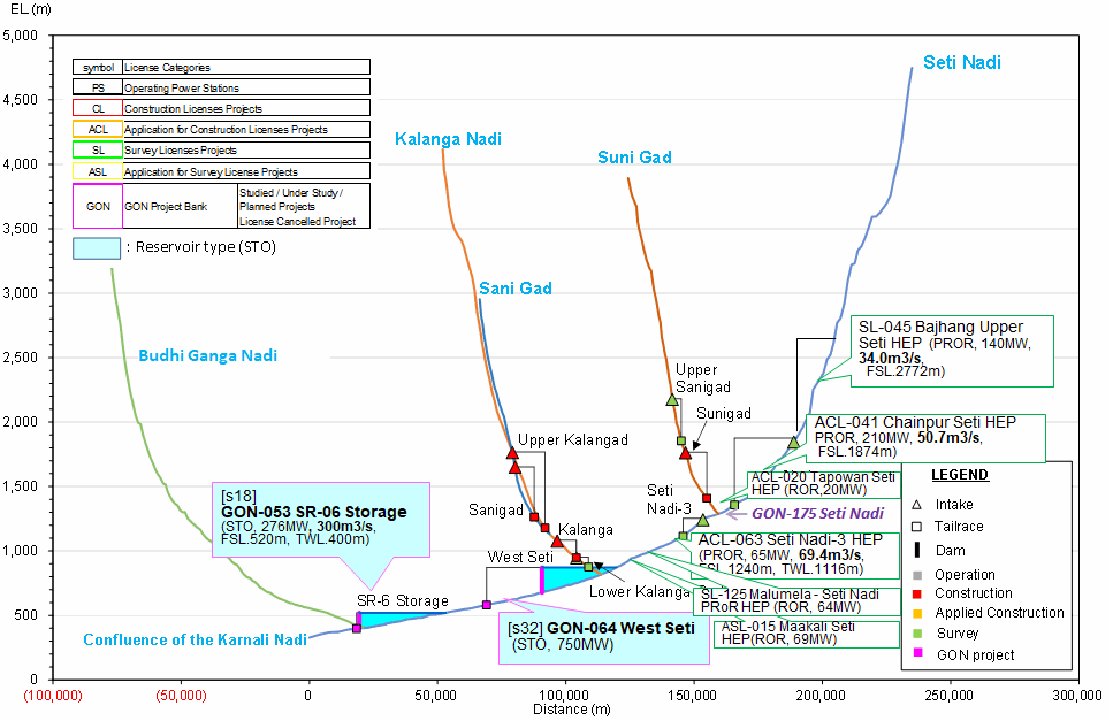
Summary
A long-stalled reservoir storage project in Sudurpashchim Province — the most prominent example of how Chinese withdrawal and project handoff have shaped Nepal's hydro-geopolitics.
Specifications
| Parameter | Value |
|---|---|
| Capacity | 750 MW |
| Status | Stalled — Chinese withdrawal 2018, NHPC takeover 2022, EIA hearings 2025 |
| River | Seti River (Karnali Basin) |
| Districts | Bajhang / Baitadi / Doti / Dadeldhura |
| Province | Sudurpashchim |
Engineering
A 195 m concrete-faced rockfill dam (CFRD), 433 m long — the largest dam design in far-west Nepal. The project's political trajectory overshadows its engineering: conceived in the 1980s, awarded to China Three Gorges Corporation (2012), abandoned by CTG (2018), transferred to India's NHPC (2022). CTG's withdrawal was not purely technical — the commercial terms and geopolitical signaling (Indian sensitivity to Chinese infrastructure near the border) were likely decisive. See Hydro-Geopolitics.
| Parameter | Value |
|---|---|
| Dam height | 195 m |
| Dam type | Concrete-face Rockfill |
| Dam length | 433 m |
| Type | Storage |
Governance
West Seti, alongside Budhigandaki Hydroelectric Project's history of Chinese-then-domestic pivots, represents a pattern: Chinese entities engage with Nepal's large storage projects but do not complete them. India then steps in — but progress remains slow. The net result is decades lost on projects that would directly address Storage Deficit.
| Parameter | Value |
|---|---|
| Developer | NHPC Limited (India, since 2022) |
| Previous developer | China Three Gorges Corporation (2012–2018) |
Schedule
No construction timeline. NHPC is conducting EIA public hearings and updating the detailed project report as of late 2025. An associated project — SR-6 (450 MW) — has been proposed. Neither has a committed construction start. See Buildability.
Limitations & Controversies
Four decades of modality changes with zero construction. Conceived in the 1980s, held by SMEC for 17 years, awarded to CTG (2012), abandoned (2018), transferred to NHPC (2022), and still in EIA hearings as of late 2025. Each handoff resets the timeline.
Chinese withdrawal pattern. CTG's 2018 withdrawal — citing geological issues, altitude, and resettlement — fits a broader pattern where Chinese entities engage Nepal's large storage projects but do not complete them. The net result is decades lost on storage that would directly address Storage Deficit.
No committed construction timeline. NHPC is updating the DPR and conducting EIA hearings, but no construction start has been announced. The associated SR-6 project (450 MW) is similarly undated.
Geopolitical sensitivity. India's sensitivity to Chinese infrastructure near the border contributed to CTG's unfavorable operating environment. The NHPC takeover resolves the China problem but does not resolve the engineering, resettlement, or financing challenges.
Timeline of Stalling
| Year | Event |
|---|---|
| ~1980s | Project conceived |
| 2001–2011 | SMEC (Australia) held license; 17 years, limited progress |
| 2012 | Awarded to China Three Gorges Corporation (CTG) |
| 2018 (Sep) | CTG withdrew — cited geological issues, high altitude, resettlement difficulty. Rejected Nepal's proposal to reduce capacity from 750 to 620 MW |
| 2022 (Sep) | Transferred to India's NHPC Limited |
| 2025 (Oct) | Public hearings begun for Environmental Impact Assessment |
Current Status (as of late 2025)
- NHPC (India) is conducting EIA public hearings across affected areas
- Detailed project report is being updated
- An associated project — SR-6 (450 MW) — has been proposed below the confluence of Seti River and Budhiganga, in Doti/Achham districts, with a 207 m dam and potential 652 MW capacity
- No construction timeline announced
Why China Left
CTG's withdrawal was not purely technical. The project illustrates the limits of Chinese hydropower engagement in Nepal:
- Geological and altitude risk — genuine engineering concerns in far-west Nepal
- Resettlement complexity — Nepal lacked a clear R&R framework
- Commercial terms — Nepal proposed PPA payment in USD (unusual for Nepal), and CTG rejected a capacity reduction
- Geopolitical signaling — India's sensitivity to Chinese infrastructure in border-adjacent areas created an unfavorable operating environment
Significance
West Seti, alongside Budhigandaki Hydroelectric Project's history of Chinese-then-domestic pivots, represents a pattern: Chinese entities engage with Nepal's large storage projects but do not complete them. India then steps in (NHPC for West Seti, domestic for Budhigandaki) — but progress remains slow. The net result is decades lost on storage projects that would directly address Storage Deficit.
Related
- Hydro-Geopolitics — the China-India triangulation
- Storage Deficit — what West Seti would help solve
- Budhigandaki Hydroelectric Project — parallel trajectory of Chinese withdrawal, domestic/Indian pivot
- Pancheshwar Multipurpose Project — another stalled storage mega-project, for different reasons