Budhigandaki Hydroelectric Project
A proposed 1,200 MW storage project with active company notices but unresolved financing, resettlement and construction-readiness evidence.
- Page status
- Working page
- Updated
- 2026-07-10
- Last reviewed
- 2026-11-04
- Review due
- 2027-02-04
Summary
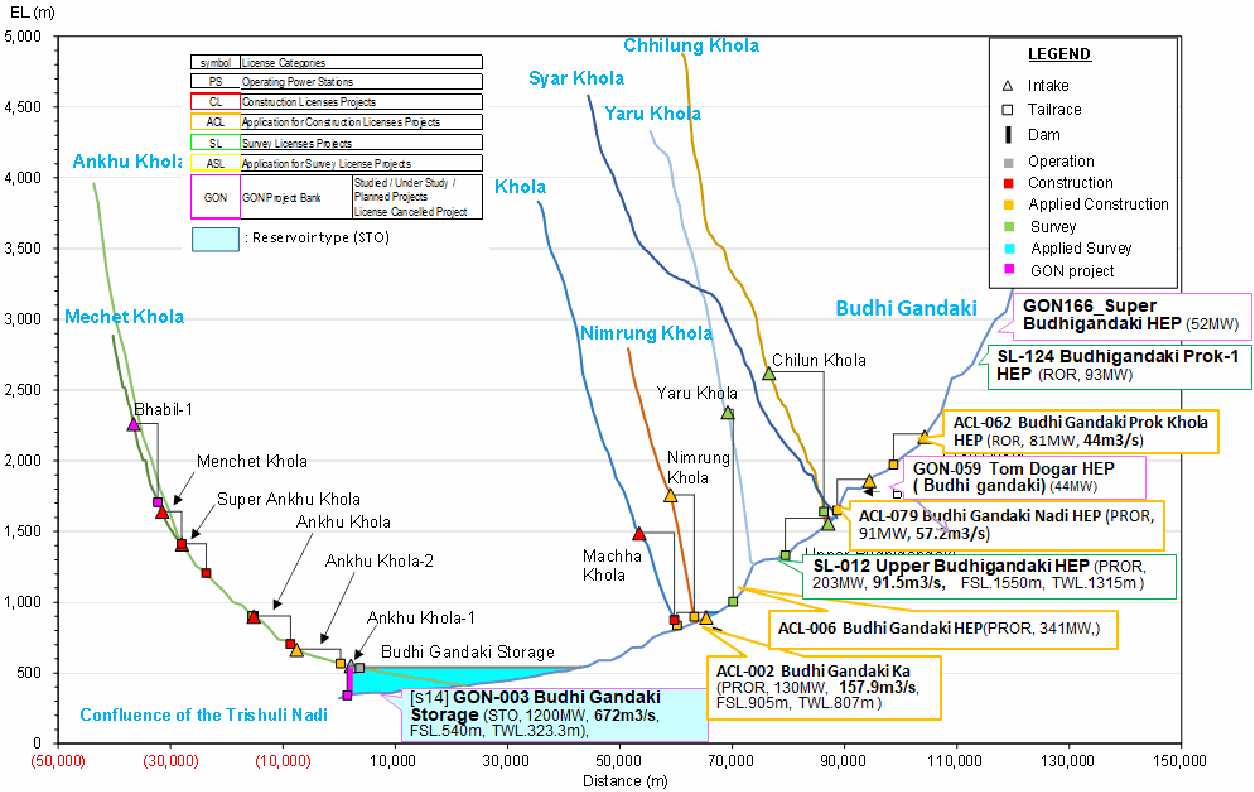
A proposed 1,200 MW reservoir storage project on the border of Gorkha and Dhading districts in the Gandaki Basin. BGJCL's current public record gives a 263 m dam and 3,338 GWh of annual design energy and shows active procurement notices. Those notices demonstrate pre-construction activity, not construction commencement or financial close.
Specifications
| Parameter | Value |
|---|---|
| Capacity | 1,200 MW |
| Status | Pre-construction; active procurement notices |
| River | Budhi Gandaki (Gandaki Basin) |
| Districts | Gorkha / Dhading |
Engineering
A 263 m double-curvature arch dam — Nepal's largest planned dam structure — with a reservoir volume of 3.3 km³. This is a different engineering class from every operating plant in Nepal's fleet. The reservoir area (63 km²) and displacement footprint (8,117 households) make this as much a social infrastructure project as a hydropower one. See Sediment as Design Constraint for the engineering challenges of a dam on the sediment-heavy Gandaki system.
| Parameter | Value |
|---|---|
| Dam height | 263 m |
| Dam type | Double-curvature Arch |
| Reservoir area | ~63 km² |
| Total storage | 3,300 MCM |
| Type | Storage / Reservoir |
Output
BGJCL's current public project page gives 3,338 GWh of annual energy. Earlier wiki records used 3,380 GWh and a 1,410 GWh dry-season value; the annual total has been aligned to the current official page, while the seasonal split remains a historical design figure pending a direct DPR or company source.
| Parameter | Value |
|---|---|
| Annual design energy | 3,338 GWh current BGJCL figure |
| Historical alternate | 3,380 GWh |
| Dry-season split | Requires direct current design source |
Financial
The current BGJCL notices do not establish a complete financing package, executed PPA or financial close. Earlier debt/equity, tariff, revenue and total-cost figures are treated as historical proposals until their underlying approved documents are ingested.
| Parameter | Value |
|---|---|
| Financial close | Not established |
| Executed PPA | Not established in current source set |
Governance
The current project company is Budhigandaki Jalbidhyut Company Limited. Historical developer and investment-modality proposals should be read as dated governance events rather than assumed current financing terms.
| Parameter | Value |
|---|---|
| Developer | Budhigandaki Jalbidhyut Company Limited |
Schedule
BGJCL was publishing procurement notices in June and July 2026, including a letter of intent on 8 July. The public record does not yet establish a firm construction-start or commercial-operation date.
| Parameter | Value |
|---|---|
| Construction start | Not established in current primary record |
| Commercial operation | Not established in current primary record |
Current Status and Performance Provenance
As of 10 July 2026: pre-construction with active company and procurement activity. Construction readiness remains dependent on a complete financing package, resettlement/compensation evidence and major-works procurement.
| Dimension | Current position | Evidence |
|---|---|---|
| Technical basis | 1,200 MW; 263 m dam; 3,338 GWh annual energy | BGJCL project page |
| Procurement | Letter of intent and financial-bid notices published | BGJCL notices |
| Finance | Full package and financial close not established | Current evidence gap |
| Construction | Not established as commenced | 10 Jul 2026 verification |
Recent Updates
| Date | Update |
|---|---|
| 8 Jul 2026 | BGJCL published a letter-of-intent notice |
| 23–30 Jun 2026 | BGJCL published financial-bid opening notices and an addendum |
Active Blockers
| Blocker | Prevents | Required evidence |
|---|---|---|
| Complete financing package is not public | Financial close and major construction | Approved financing agreements and effectiveness |
| Current compensation/resettlement completion is not established | Construction readiness | Project-company or government implementation disclosure |
| Exact design figures differ across public records | Stable public specification baseline | Current approved DPR/salient-features document |
Limitations & Controversies
- Evidence coverage. The current official site is strong for headline design and procurement notices but thin on a consolidated, current financing and resettlement dashboard.
- Design reconciliation. Public annual-energy figures include 3,338 and 3,380 GWh; the current company figure is used here, with the older value preserved as a discrepancy.
- Social footprint. Historical sources report a large land and resettlement programme, but the current completion percentage and household totals require direct implementation reporting before being repeated as current facts.
- Seismic and sediment exposure. A 263 m Himalayan arch dam requires project-specific seismic, sediment and dam-safety evidence. See Sediment as Design Constraint and Buildability.
- Procurement is not construction. A letter of intent or bid-opening notice shows administrative progress but does not establish notice to proceed, mobilisation or physical completion.
Why It Matters
If built, Budhigandaki would not just add generation — it would change the economic character of Nepal's electricity system. It addresses Storage Deficit, Seasonal Mismatch, and Firm Power simultaneously. The revenue difference from shifting monsoon water to dry-season generation at higher prices makes storage an economic optimization instrument, not just infrastructure.
Map Assets

Related
- Storage Deficit — the gap Budhigandaki would address
- Seasonal Mismatch — the problem its winter output solves
- Firm Power — why the verified seasonal design split matters for reliability
- Pancheshwar Multipurpose Project — the bilateral mega-project that hasn't moved
- Domestic-Led Hydro Strategy — the thesis Budhigandaki supports
- Sediment as Design Constraint — the engineering challenge of Gandaki sediment
- Buildability — why modality approval ≠ operational dam