Kulekhani Cascade
- Page status
- Working page
- Updated
- 2026-05-21
Summary
Nepal's only operating reservoir hydropower system. A cascade of three plants on the Kulekhani River, approximately 50 km south of Kathmandu in Makwanpur district. Built with World Bank support in the 1970s–1980s, it remains — 40+ years later — the single operational counterexample to Nepal's otherwise entirely run-of-river fleet.
Specifications
| Plant | Capacity (MW) | Type | Page |
|---|---|---|---|
| Kulekhani I | 60 | Reservoir | Kulekhani I |
| Kulekhani II | 32 | Cascade | Kulekhani II |
| Kulekhani III | 14 | Cascade | Kulekhani III |
| Total | 106 |
- Combined generation in FY 2081/82: 279.8 GWh (KL-I: 170.56 + KL-II: 74.9 + KL-III: 34.3)
- Storage volume: ~85–150 MCM (see Storage Capacity Comparison)
- The Kulekhani I dam (Indra Sarobar) is a 114 m rockfill dam impounding the Kulekhani River
Engineering
Kulekhani I is a seasonal-storage reservoir: a 114 m rockfill dam creates a headpond that captures monsoon inflow (June–September) and releases it through the dry season (November–May) to Kulekhani II and III downstream. This is the only facility in Nepal where water can be stored in one season and released in another for power generation. Every other plant is Run-of-River Hydropower.
The cascade operation means KL-I releases become KL-II inflow, and KL-II releases become KL-III inflow — a true cascade, not three independent plants. This operational interdependence means Kulekhani's value is in the system, not any individual turbine.
| Parameter | Value |
|---|---|
| Kulekhani I dam height | 114 m |
| Kulekhani I dam type | Rockfill |
| Storage type | Seasonal-storage reservoir |
| Cascade operation | KL-I → KL-II → KL-III |
Output
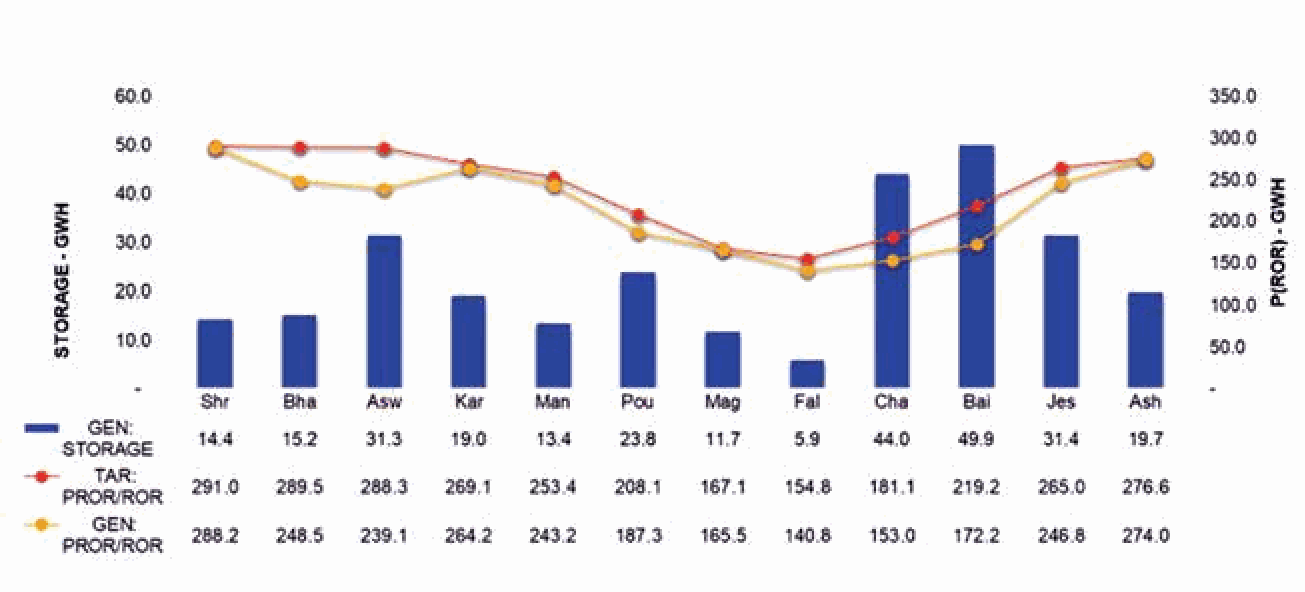
Kulekhani's seasonal generation pattern is what distinguishes it from RoR. While RoR plants generate 70–80% of their annual energy in the four monsoon months, Kulekhani shifts a substantial portion into the dry season. The combined 279.8 GWh in FY 2081/82 is modest by total-hydro standards (3% of national generation), but its timing — concentrated in the dry months and peak evening hours — provides Firm Power that no RoR plant can match.
| Parameter | Value |
|---|---|
| Annual generation (FY 2081/82) | 279.8 GWh |
| KL-I generation | 170.56 GWh |
| KL-II generation | 74.9 GWh |
| KL-III generation | 34.3 GWh |
Grid Services
Beyond energy, Kulekhani provides services that RoR plants cannot:
- Black start capability — KL-I can restart the Kathmandu valley grid without external power, a critical grid-resilience function
- Peak-hour dispatch — the reservoir can ramp generation to match evening peak demand (~6–10 PM), when RoR plants are output-limited by declining diurnal flows
- Frequency regulation — turbine response to load changes supports grid frequency stability in a system with growing variable solar
These services are not priced in the PPA, which pays the same NPR/kWh as any RoR plant. The value of storage is captured in grid reliability, not in Kulekhani's revenue line. This is part of the broader PPA Pricing challenge: Nepal's tariff structure does not compensate storage for the services it uniquely provides.
Schedule
Kulekhani I was commissioned in 1982, making it Nepal's first major storage hydropower project — and, 40+ years later, still its only one. The cascade additions (KL-II in 1986, KL-III in 2019) extended the system but did not add new reservoir capacity. Compare with the pipeline: Tanahu Hydropower Project (140 MW storage, ~67% complete in the NEA FY 2024/25 baseline and ~75% in an April 2026 public update) and Dudhkoshi Storage Hydroelectric Project (635 MW, pre-construction) are the next storage projects that would break this four-decade monopoly.
| Parameter | Value |
|---|---|
| Kulekhani I commissioned | 1982 |
| Kulekhani II commissioned | 1986 |
| Kulekhani III commissioned | 2019 |
| Age of Nepal's only storage anchor | 40+ years |
Historical Context
Kulekhani was built with World Bank financing in the late 1970s as part of Nepal's first generation of utility-scale hydropower. At the time, Nepal had fewer than 100 MW of installed capacity, nearly all run-of-river. The choice to build a storage reservoir 50 km from Kathmandu — rather than another RoR plant on a larger river — reflected a specific calculation: the capital city needed reliable dry-season power, and proximity to load mattered more than scale.
The project was completed on time and on budget, and has operated continuously for over 40 years. But the model was never replicated. Every subsequent NEA project — Kali Gandaki A (144 MW, 2002), Upper Tamakoshi (456 MW, 2021) — chose the RoR engineering model. The reasons are instructive: storage dams require larger upfront capital, longer construction timelines, resettlement programs, and environmental approvals that RoR diversion schemes avoid. In a system where NEA's capital budget was always constrained and political cycles are short, the RoR model won every time after Kulekhani.
The result: 106 MW of storage in 1982, 106 MW of storage in 2026. Four decades of hydropower expansion added ~3,300 MW of RoR capacity with zero additional reservoir storage. Kulekhani is not simply an exception to Nepal's RoR-heavy pattern; it is the exception that became the rule, a data point that could have become the first of many and instead became the only one.
The Storage Paradox
The Storage Deficit page describes the arithmetic: Nepal's ~3,400+ MW of installed hydro is over 95% run-of-river, generating ~70–80% of annual energy in the four monsoon months. Kulekhani — 106 MW, ~3% of installed capacity — is the only plant that can time-shift water across seasons.
This ratio (106:3,400) is the number behind every argument in this wiki about Seasonal Mismatch and Firm Power. It means that in the driest months (February–April), when national demand peaks and river flows bottom, the entire storage-dependent portion of the grid is 106 MW. Everything else depends on whatever the rivers are carrying that day.
The pipeline projects that would change this ratio — Tanahu Hydropower Project (140 MW), Dudhkoshi Storage Hydroelectric Project (635 MW), Budhigandaki Hydroelectric Project (1,200 MW) — would bring the storage-to-RoR ratio from 1:32 to roughly 1:3 if all are completed. But Kulekhani has been carrying this burden alone since 1982.
Sedimentation
As Nepal's oldest operating reservoir, Kulekhani is also the best data point for Sediment as Design Constraint. The Kulekhani catchment drains the Mahabharat range, and monsoon sediment inflow has been gradually reducing the reservoir's active storage volume. The original design assumed a 50-year sediment life, meaning the reservoir would lose roughly 1–2% of active storage per year to silt accumulation.
If this assumption holds, Kulekhani I's active storage has declined from ~85 MCM at commissioning to approximately 50–60 MCM today — a loss of roughly one-third of its original regulation capacity. This is not a crisis (the reservoir still functions), but it is a warning for every planned storage project with a 50–100 year design life: Himalayan sediment loads make "dead storage" a dynamic quantity, not a design-time constant.
Significance
Kulekhani is the outlier in Nepal's generation fleet. It is the only facility in Nepal that can shift water from wet to dry season for power generation. Everything else is Run-of-River Hydropower. The fact that 106 MW of storage represents Nepal's entire reservoir base — against 3,400+ MW of total hydro — encapsulates the Storage Deficit.
Kulekhani is also evidence that storage can operate in Nepal. A 40-year operating history with World Bank financing, on-time construction, and continuous dry-season service shows that the model has a domestic precedent. The question is not whether Nepal has built storage — it already did. The question is why it stopped.
Limitations & Controversies
Sedimentation. As Nepal's oldest operating reservoir, Kulekhani I has gradually lost active storage volume to monsoon sediment inflow from the Mahabharat range catchment. If the original 50-year sediment-life assumption holds, active storage has declined from ~85 MCM at commissioning to approximately 50–60 MCM today — a loss of roughly one-third of its original regulation capacity.
Single-point-of-failure risk. At 106 MW and 40+ years of operation, Kulekhani is the only facility in Nepal providing seasonal water storage for power generation. Equipment aging and the absence of any backup reservoir create concentrated grid-reliance risk.
Scale ceiling. Even at full original capacity, Kulekhani's storage volume is insufficient to close the national dry-season gap on its own. It provides roughly 3% of national generation but must carry the entire seasonal time-shifting burden for the grid.
Related
- Kulekhani I — the upper reservoir plant (60 MW)
- Kulekhani II — the second cascade plant (32 MW)
- Kulekhani III — the third cascade plant (14 MW)
- Storage Capacity Comparison — Nepal's storage in international context
- Storage Deficit — why this matters
- Firm Power — what Kulekhani can provide that RoR cannot
- Sediment as Design Constraint — the silent erosion of reservoir value
- Tanahu Hydropower Project — the next storage project (140 MW, under construction)
- Dudhkoshi Storage Hydroelectric Project — the next major storage candidate (635 MW)
- PPA Pricing — why storage services are not compensated
