Arun 3
A 900 MW project under construction whose generating works, evacuation line and changing commissioning expectations are tracked separately.
- Page status
- Working page
- Updated
- 2026-07-10
- Last reviewed
- 2026-11-04
- Review due
- 2027-02-04
Summary
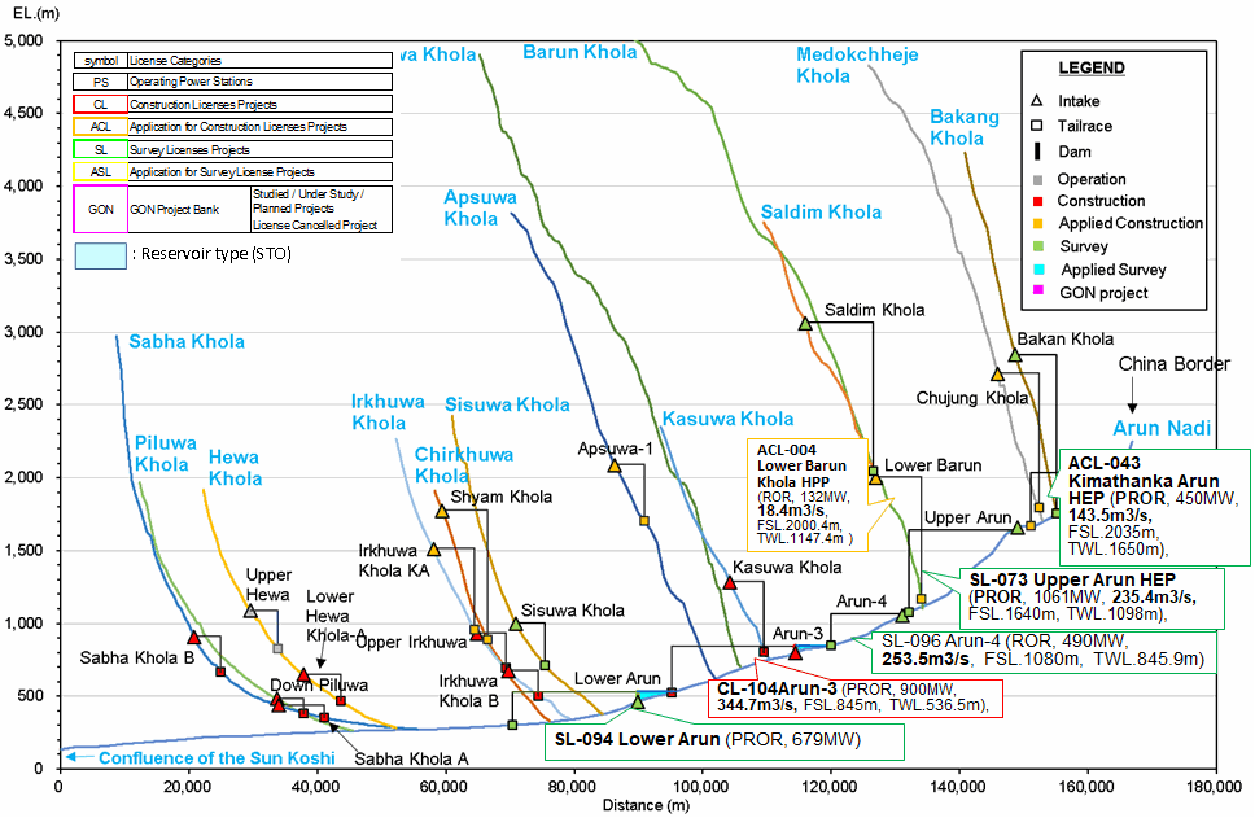
Nepal's single largest project under construction — a 900 MW peaking run-of-river scheme on the Arun River in Sankhuwasabha, developed by India's state utility SJVN through SAPDC. The project is under construction, but the wiki no longer presents September 2026 as a firm commissioning date: public percentages and schedule statements use different dates and scopes, and the 217 km evacuation line must be tracked separately from the generating works.
Specifications
| Parameter | Value |
|---|---|
| Capacity | 900 MW |
| Status | Under construction; current comparable completion percentage not established |
| River | Arun (eastern Koshi Basin) |
| District | Sankhuwasabha |
Engineering
Arun-3 is designed as a peaking RoR plant — 3.4 hours of full rated output per day, delivered through an underground powerhouse with four Francis turbines. This means its 900 MW nameplate translates into a much smaller day-long energy contribution than its capacity suggests. Compare with Upper Tamakoshi (456 MW continuous RoR) for the contrast in fleet-shape implications.
| Parameter | Value |
|---|---|
| Units | 4 × 225 MW |
| Turbine type | Francis |
| Type | Peaking run-of-river |
| Evacuation | 400 kV DC line to Sitamarhi, Bihar |
Output
SJVN's current project description gives design energy of 4,018.87 GWh in a 90%-dependable year. The PDA includes a 21.9% free-energy share for Nepal; the timing and dependable capacity value of that energy should not be inferred from the annual GWh figure alone.
| Parameter | Value |
|---|---|
| Annual design energy | 4,018.87 GWh (90%-dependable year) |
| Nepal free share | 21.9% (~197 MW equivalent) |
| Peaking duration | ~3.4 hours/day at full output |
Financial
Arun-3 is structured as a 30-year BOOT concession. The current dossier does not use a single project-wide progress percentage to infer the financial or commissioning position because civil works, generation equipment and evacuation have different delivery paths.
| Parameter | Value |
|---|---|
| Concession | 30-year BOOT |
Governance
SJVN, an Indian state utility, develops, owns, and operates the project through its subsidiary SAPDC. This is the reference case for India-developed export-first hydropower in Nepal — a structure that the Domestic-Led Hydro Strategy thesis argues against for strategic capacity control.
| Parameter | Value |
|---|---|
| Developer | SJVN Arun-3 Power Development Company (SAPDC) |
| Lead financier | SJVN (Indian state utility) |
| Concession period | 30 years |
Schedule
Earlier commissioning targets have moved. A reliable current forecast requires separate dated milestones for the generating works and the 217 km 400 kV evacuation component.
| Parameter | Value |
|---|---|
| Completion | Not stated as a single current comparable figure |
| COD target | FY 2028/29 Q3 in SJVN's May 2026 investor presentation; an announced expectation, not a firm forecast |
Current Status and Performance Provenance
As of 10 July 2026: under construction. SJVN recorded a management review on 8 December 2025, but that event does not supply a comparable project-wide progress denominator.
| Dimension | Current position | Evidence basis |
|---|---|---|
| Generation works | Under construction | SJVN Arun III project page |
| Evacuation | 217 km 400 kV component under delivery with the project | SJVN corporate description |
| Design energy | 4,018.87 GWh in a 90%-dependable year | SJVN project page |
| Commissioning | FY 2028/29 Q3 expectation announced by SJVN; firm date not established | SJVN, May 2026 |
Recent Updates
| Date | Update |
|---|---|
| 23 May 2025 | SJVN described FY 2027/28 as the project's expected commissioning period in a power-sale announcement |
| 8 Dec 2025 | SJVN management recorded a review of Arun-3 progress |
| May 2026 | SJVN's investor presentation listed FY 2028/29 Q3 as the expected commissioning schedule, superseding the earlier FY 2027/28 expectation |
| 10 Jul 2026 | Structured record changed from a stale single percentage/COD to component-aware monitoring |
Active Blockers
| Blocker | Prevents | Monitoring requirement |
|---|---|---|
| Incomparable public progress percentages | Reliable completion forecast | Record date, denominator and package for every percentage |
| Generation and evacuation schedules may diverge | Commercial operation and export | Track powerhouse and 217 km line separately |
Significance
Arun-3 is the archetype of Nepal's India-developed export-first project class. Under the 2014 Project Development Agreement, SJVN builds, owns and operates the plant for 30 years, gives Nepal 21.9% of the energy as royalty-free share, offers another 10% on commercial terms, and takes the remainder to the Indian grid — a structure that makes Arun-3 the reference case when discussing Hydro-Geopolitics in the basin.
It also changes the shape of Nepal's fleet, not just the size. Arun-3 is designed as a peaking RoR plant — 3.4 hours of full rated output per day, not continuous. So its 900 MW nameplate translates into a much smaller day-long energy contribution than its capacity suggests. That matters because Nepal's structural problem isn't capacity; it's Seasonal Mismatch and Firm Power deficits in dry months, which a peaking RoR plant can help with only to the extent the transmission system can absorb concentrated evening blocks.
Compared to Upper Tamakoshi — which is Nepali-developed, Nepali-dispatched, and continuous-RoR at 456 MW — Arun-3 is larger but strategically narrower: more export value than domestic reliability value.
Limitations & Controversies
Repeated schedule changes. Earlier commissioning targets have moved. The current page therefore treats target dates as dated events, not as a guaranteed operating date.
Evacuation dependency. The 217 km 400 kV evacuation component is a separate critical path. A current component-level percentage is needed before its readiness can be compared with the generating works.
Free power as compensation theory. The 21.9% free share is the political justification for allowing the dominant share of the energy and revenue to accrue to India. Whether 21.9% is a good deal for Nepal depends on (a) the counterfactual — would the project have been built by a Nepali developer at all, and on what timeline — and (b) how the free share interacts with dry-season Firm Power accounting, which Arun-3's peaking design constrains.
Official Visual References
SAPDC's monthly progress reports are a materially better official visual source than the generic Arun riverside imagery that often gets used as a placeholder for the project. The February 2023 report cover contains a compact one-page schematic tying together the intake, headrace, surge shaft, powerhouse and tailrace alignment.
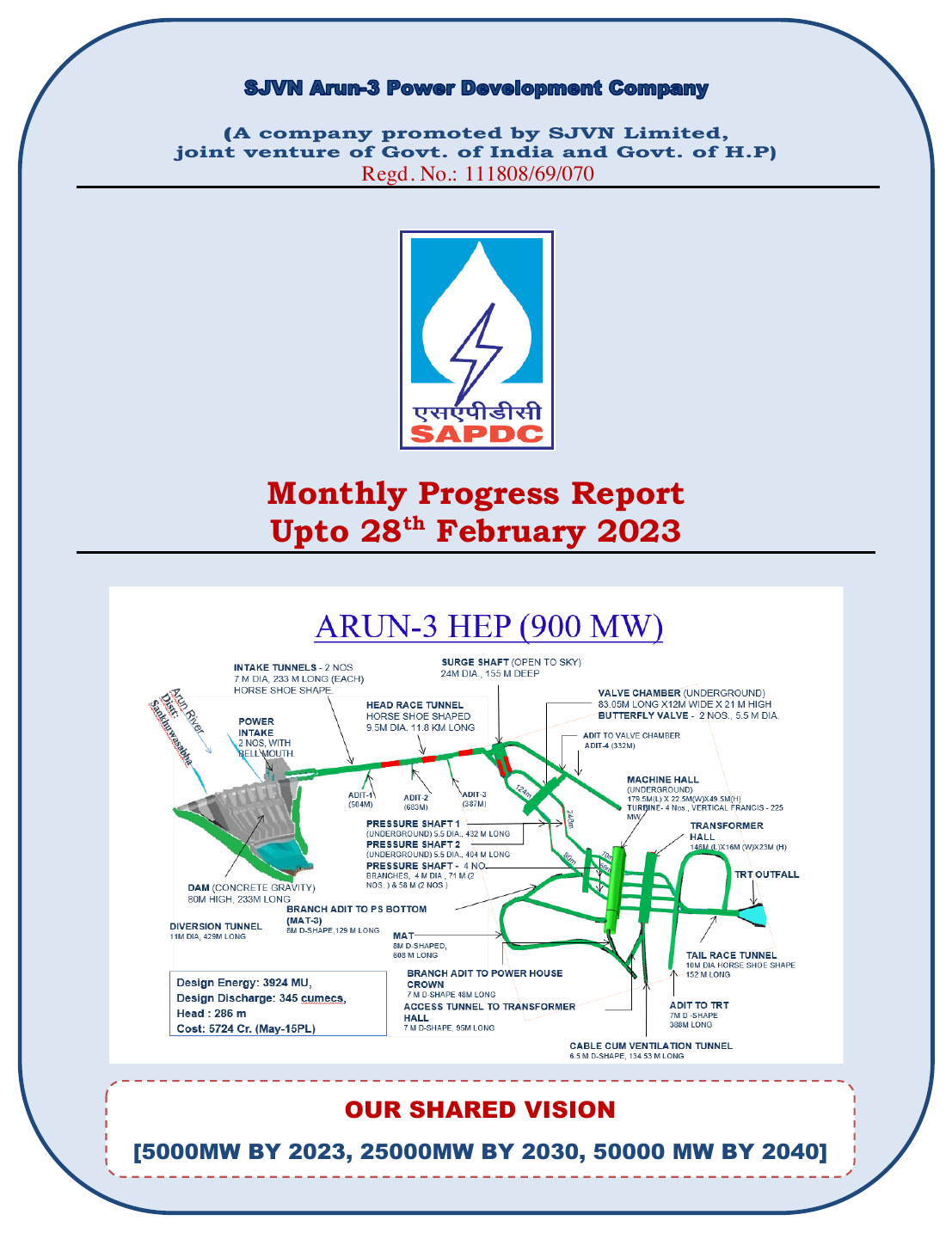
Source: SAPDC monthly progress report up to 28 February 2023 (PDF)
See also
- Koshi Basin
- Upper Tamakoshi
- Hydro-Geopolitics
- Stranded Generation
- Firm Power
- Seasonal Mismatch
- Inaruwa–Purnea 400 kV Cross-Border Interconnection — the 400 kV line being built to evacuate Arun-3