Dudhkoshi Storage Hydroelectric Project
A proposed 670 MW storage scheme with a current design and appraisal trail, but no verified financial close or construction start.
- Page status
- Working page
- Updated
- 2026-07-10
- Last reviewed
- 2026-11-04
- Review due
- 2027-02-04
Summary
A proposed 670 MW storage reservoir scheme straddling Okhaldhunga, Khotang and Solukhumbu in the eastern Koshi Basin. The February 2026 AIIB and DKJVCL materials describe a 600 MW underground main powerhouse and a 70 MW dam-toe ecological-flow powerhouse. The project is in pre-construction development and market sounding: AIIB financing is proposed, not approved or effective, and no current primary source establishes a firm construction start or commercial-operation date.
Specifications
| Parameter | Value |
|---|---|
| Capacity | 670 MW current design basis; 635 MW retained as a historical variant |
| Status | Pre-construction / market sounding; financing proposed |
| River | Dudh Koshi (Koshi Basin) |
| Districts | Okhaldhunga, Khotang, Solukhumbu |
Engineering
Dudhkoshi's current published design pairs a 220 m dam with an underground main powerhouse (600 MW) and a dam-toe ecological-flow powerhouse (70 MW). The current AIIB project summary and 2026 market-sounding teaser do not establish the previously listed 200 MW pumped-storage component, so that figure has been removed from the structured specification record pending a primary design source. The project's safeguard work explicitly includes sediment, slope, seismic, biodiversity and GLOF Risk assessment.
| Parameter | Value |
|---|---|
| Dam height | 220 m current basis |
| Main powerhouse | 600 MW (underground) |
| Dam-toe powerhouse | 70 MW (ecological flow) |
| Underground powerhouse | Yes |
| Type | Storage |
Storage
The published project record uses approximately 1,581 MCM of total storage. That figure remains in the structured registry, but the current AIIB summary does not publish every reservoir parameter; detailed design documents should remain the authority for gross, live and operating storage. Compare the scale with Kulekhani Cascade and the 140 MW Tanahu Hydropower Project project under construction.
| Parameter | Value |
|---|---|
| Total storage | 1,581 MCM |
Output
The current structured design record uses approximately 3,377 GWh of annual energy and 1,252 GWh of dry-season energy. Dispatch and revenue outcomes remain design assumptions until the operating rule curve, PPA and final financing documents are disclosed.
| Parameter | Value |
|---|---|
| Annual design energy | 3,377 GWh |
| Dry-season design energy | 1,252 GWh |
Financial
AIIB lists USD 200 million of proposed sovereign financing and names ADB as lead co-financier. This is only part of the project's estimated capital requirement and must not be described as financial close, approval, effectiveness or disbursement.
| Parameter | Value |
|---|---|
| Total cost | ~USD 2.2 billion |
| Owner | NEA |
| Lead co-financier | ADB |
| AIIB amount | USD 200 million proposed |
Schedule
The project remains before financing approval and construction. Earlier planning dates for a 2027 start and 2031 operation are retained as historical targets only; the current primary project summaries do not establish them as firm milestones.
| Parameter | Value |
|---|---|
| Construction start | Not established in current primary source |
| Commercial operation | Not established in current primary source |
Current Status and Performance Provenance
As of 10 July 2026: proposed / pre-construction. The project has a current design basis, market-sounding material and proposed multilateral financing, but appraisal, full financing, safeguard completion, procurement and construction commencement remain separate pending milestones.
| Dimension | Current position | Evidence date |
|---|---|---|
| Design | 600 MW main + 70 MW dam-toe powerhouse; 220 m dam | February 2026 |
| Financing | ADB lead co-financier; USD 200 million AIIB financing proposed | February 2026 |
| Safeguards | Category A / high risk; ESIA, resettlement, Indigenous Peoples, biodiversity and dam-safety instruments under preparation or review | February 2026 |
| Procurement | Market-sounding teaser issued | 2 February 2026 |
| Construction | Not started | 10 July 2026 verification |
Recent Updates
| Date | Update | Source |
|---|---|---|
| 5 Feb 2026 | AIIB published the proposed-project summary and financing envelope | AIIB project summary |
| 2 Feb 2026 | DKJVCL issued the current market-sounding teaser | Development teaser |
Active Blockers
| Blocker | Prevents | Current evidence |
|---|---|---|
| Full financing is not approved or effective | Financial close and major works procurement | AIIB lists only USD 200 million as proposed financing |
| Category A safeguard instruments remain under preparation or review | Appraisal and financing approval | AIIB project summary |
| Final design-basis reconciliation | Stable public specification record | 635 MW and 670 MW figures remain in historical materials |
Significance
Dudhkoshi matters on three documented axes:
Scale. 670 MW of proposed reservoir generation in a system where the entire current storage fleet is 106 MW (Kulekhani Cascade) and the only storage actually under construction is 140 MW (Tanahu Hydropower Project). Dudhkoshi alone would roughly match the combined 2025 hydropower fleet of Nepal on energy volume and materially change the dry-season Firm Power portfolio if built.
Seasonal storage. The reservoir and 1,252 GWh dry-season design figure make the project relevant to Seasonal Mismatch without requiring the unsupported pumped-storage claim.
Safeguard-intensive design. The project is being scoped with landscape stabilization and sediment management built in — a response to Nepal's Sediment as Design Constraint reality and to the fact that the upper Dudh Koshi routinely receives GLOF pulses from the Everest region (see GLOF Risk).
Compare Dudhkoshi (670 MW, storage, proposed multilateral financing) to Arun 3 (900 MW, peaking RoR, SJVN, export-first). Both are in the Koshi basin, but they occupy different delivery stages and have different operating purposes.
Limitations & Controversies
Four-decade gestation. The original feasibility was ADB-supported in the 1980s. Land acquisition restarted only in 2021. A project that has been "about to be built" for 40 years carries a credibility tax that any new timeline must earn against.
Displacement footprint. AIIB's preliminary summary reports about 3,300 affected households and approximately 290 households expected to be physically and economically displaced. The transmission line and access-road impacts were still being assessed at publication, so these figures are not a final project-wide resettlement total.
GLOF exposure. The 2024 Thame Valley GLOF traveled down the Dudh Koshi mainstem. A 220 m dam on a GLOF-exposed river demands a design flood that correctly accounts for cascading lake outburst scenarios, not a stationary climatology. How that design flood is set — and how conservative the spillway margin is — is the safety-critical question for the entire project.
Financing status. AIIB sovereign financing is proposed, not approved, effective or disbursed. The disclosed USD 200 million amount also covers only part of the estimated project cost.
Official Visual References
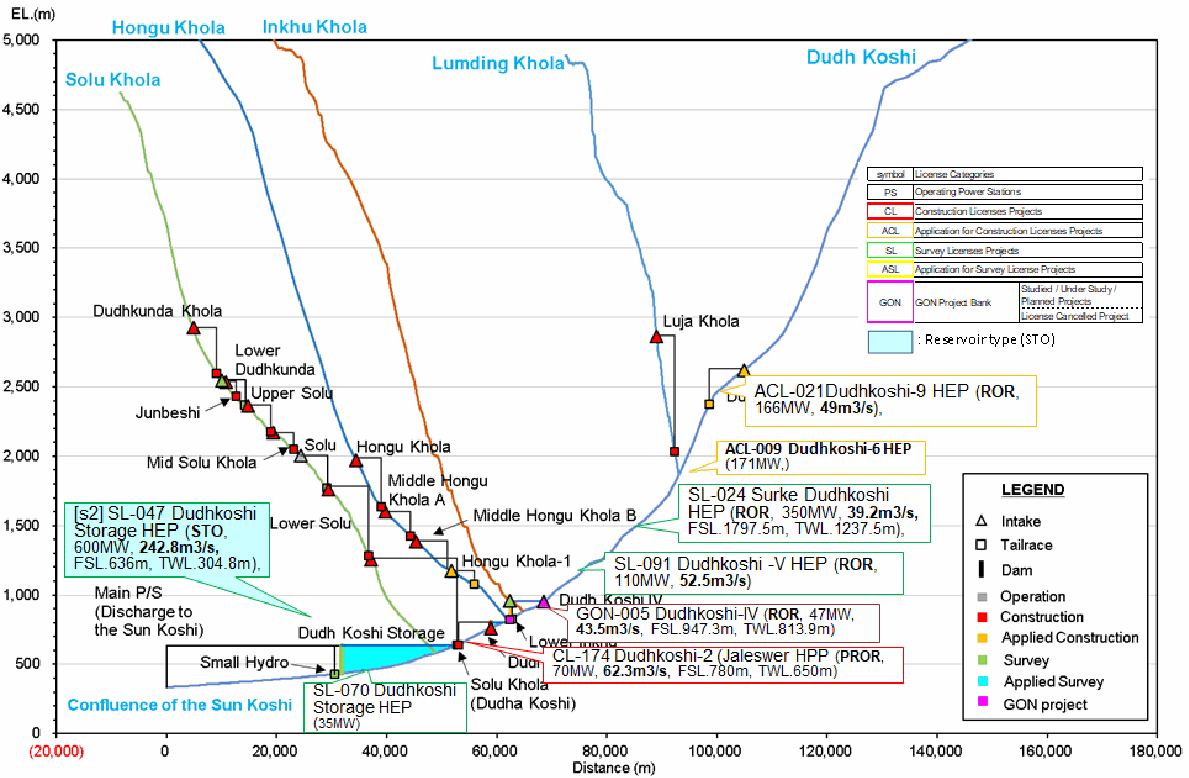
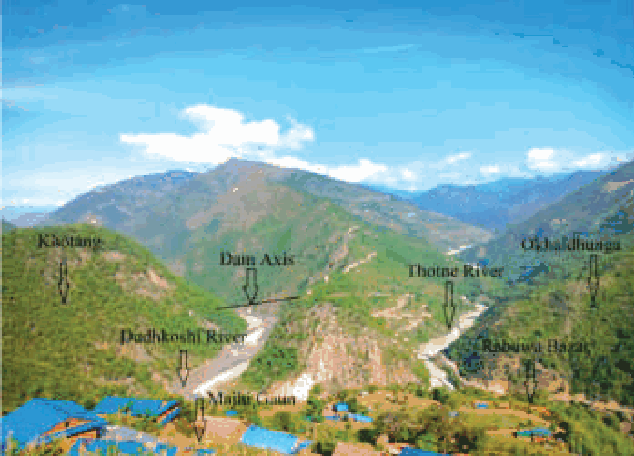
The new DKJVCL project material is a stronger visual source than the old bridge photos currently sitting in the top strip. The two most useful figure pages in the 2026 development teaser are the detailed dam-site layout and the basin study-area map.
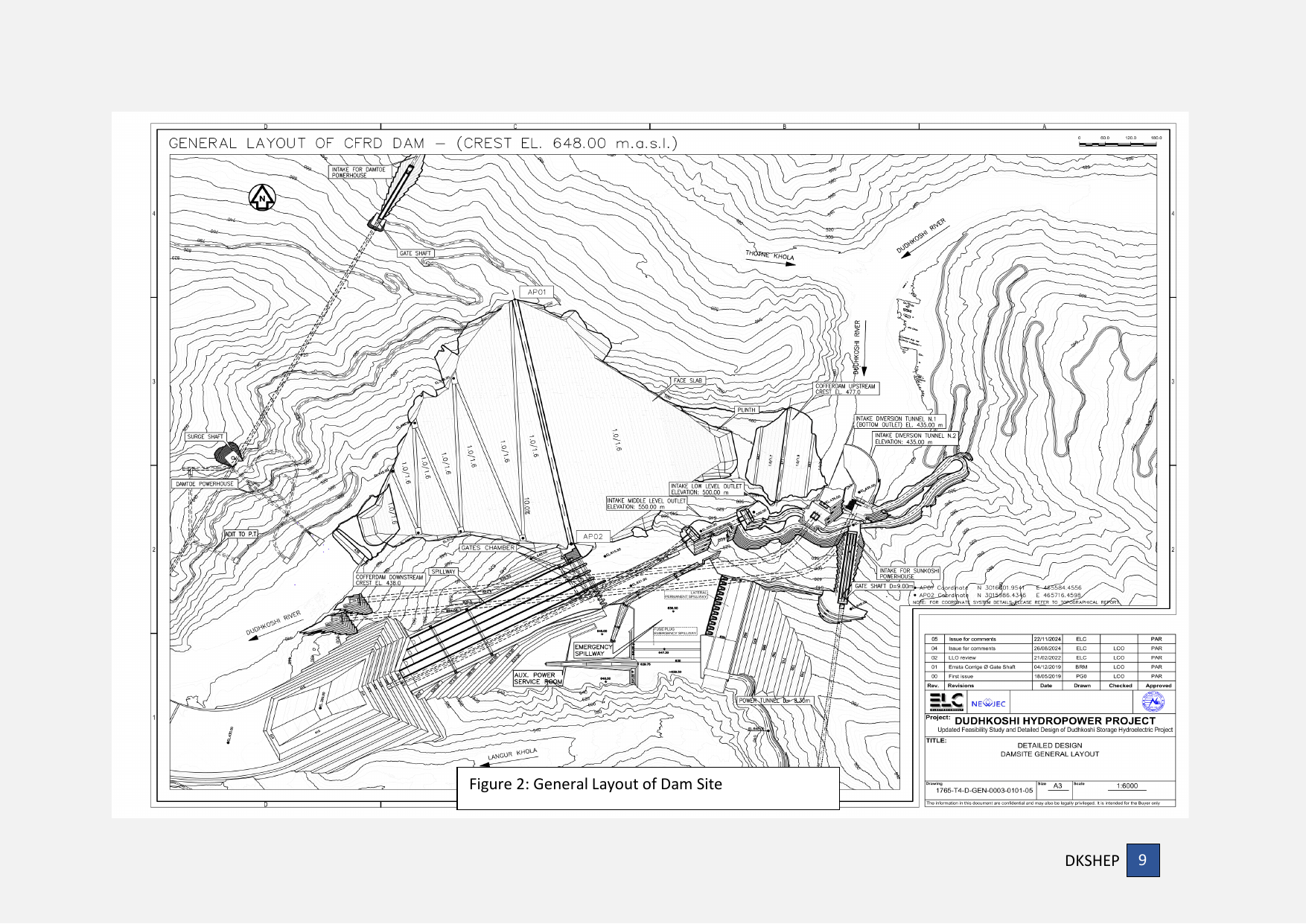
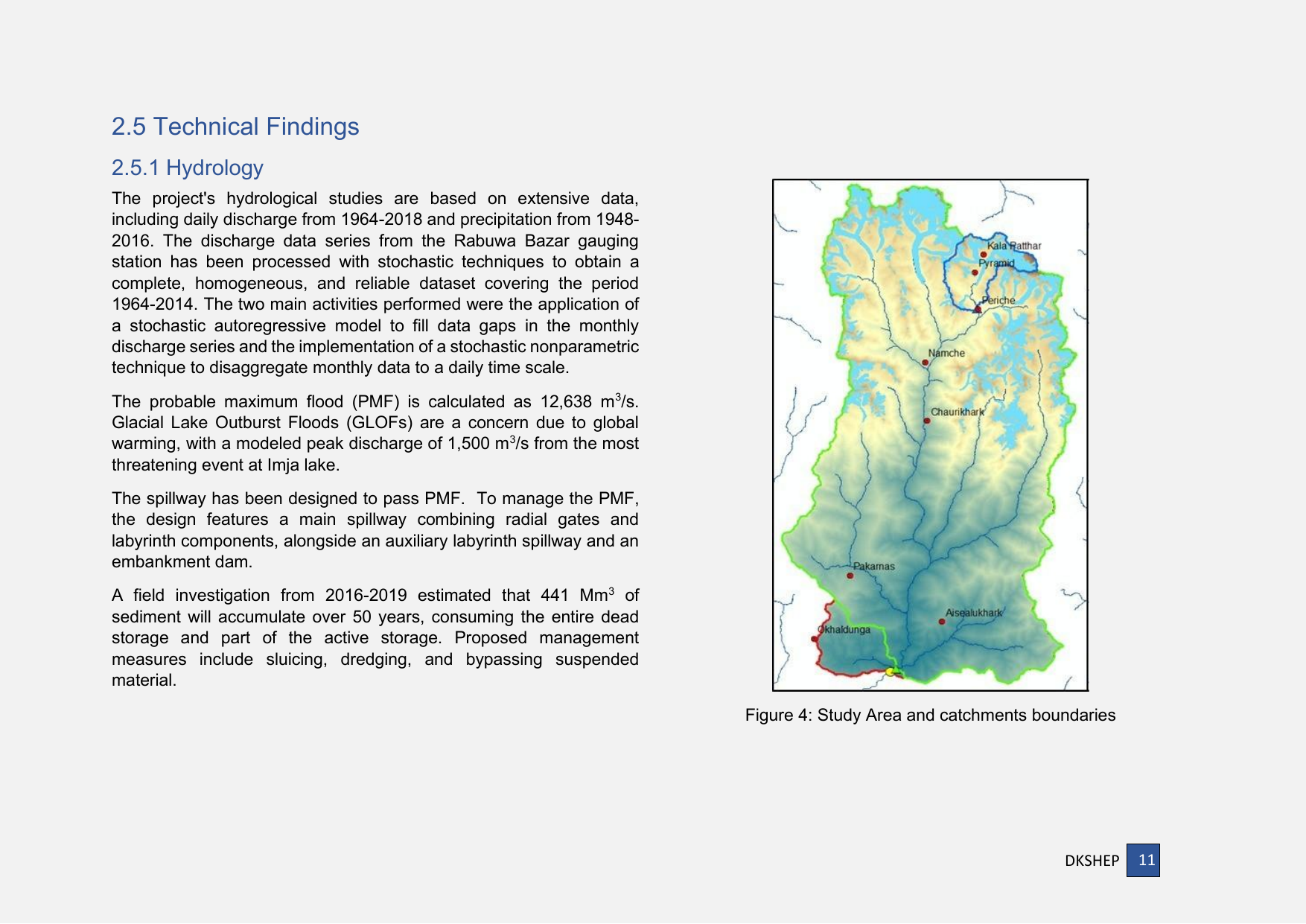
Source: Dudhkoshi Storage Hydroelectric Project Development Teaser (PDF)
Related
- Storage Deficit — what Dudhkoshi would begin to address
- Koshi Basin — the basin context
- GLOF Risk — the 2024 Thame Valley GLOF traveled down the Dudh Koshi river
- Tanahu Hydropower Project
- Firm Power
- Sediment as Design Constraint
